 VIGA kranprodusent
Ifølge vietnamesiske medier, the value of Vietnam’s imports of ceramic tiles and bathroom products from China has increased by 60-70% årlig. Many local enterprises have reduced their production scale. The Vietnamese authorities have instructed the Ministry of Construction of the country to formulate countermeasures. Vietnam had tightened the import of sanitary ware products made in China last year due to the same problem, but it seems that the effect is not obvious.
Chinese made bathrooms are growing rapidly.
Some Vietnamese companies cut production by 20%
According to a recent report from the Vietnam Youth Daily, a reporter from the newspaper visited furniture stores and retail stores in Hanoi, Ho Chi Minh City and other cities and found that the store sells a large number of ceramic tiles and bathroom products imported from China. brands including Korest, Rangerer, Varme, Kobesi , I spindelen, etc.
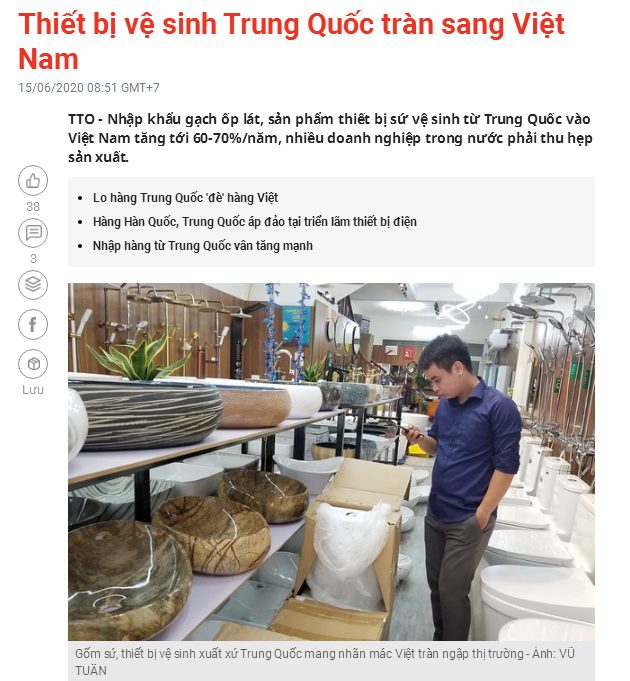
Most of these products are claimed to be produced in accordance with the process standards of South Korea and Japan, men prisen er veldig billig, such as Chinese-made “combo” bathroom products sold for less than VND 4 million (Om RMB 1,200). While the price of similar products to other common brands such as INAX, TOTO, Viglacera, is VND 6-8 million (Om RMB 1800-2500).
It is reported that many bathroom brands in Vietnam are imported from China by local distributors and then sold with locally registered trademarks. For eksempel, the staff of a ceramic tile and sanitary products distributor in Hanoi’s Ha Dong County said that all the products sold in the store have the company’s trademark, but all the products are imported from China,” you can understand that it’s a locally produced product in China and we paid for the trademark “.
Pham Van Be, Director of the Department of Materials Construction of the Ministry of Construction of Vietnam , sa det de siste årene, Vietnams import av keramiske fliser og sanitærprodukter fra Kina har økt med 60-70% every year. Some local distributors believe that the continuous increase in China’s imports of ceramic tiles and bathroom products is related to the Sino-US trade war. Because the United States raised China’s Tariffs on imported ceramic tiles and bathroom products to 250%, Chinese sanitary enterprises turned to Southeast Asia to export products.
Some Vietnamese companies have had to take the initiative to cut production due to the continuous increase in imports of Chinese tiles and sanitary products. Relevant person in charge of Viglacera Company in Binh Duong, Vietnam sa det i møte med press fra kinesiske produkter, selskapet har redusert produksjonskapasiteten med ca 20% i 2019. Som svar på denne situasjonen, the Vietnamese authorities are bringing the matter to the attention of the Ministry of Construction of the country, which is currently gathering and proposing measures to address the situation.
Not the first “tightening” of imports of Chinese sanitary products
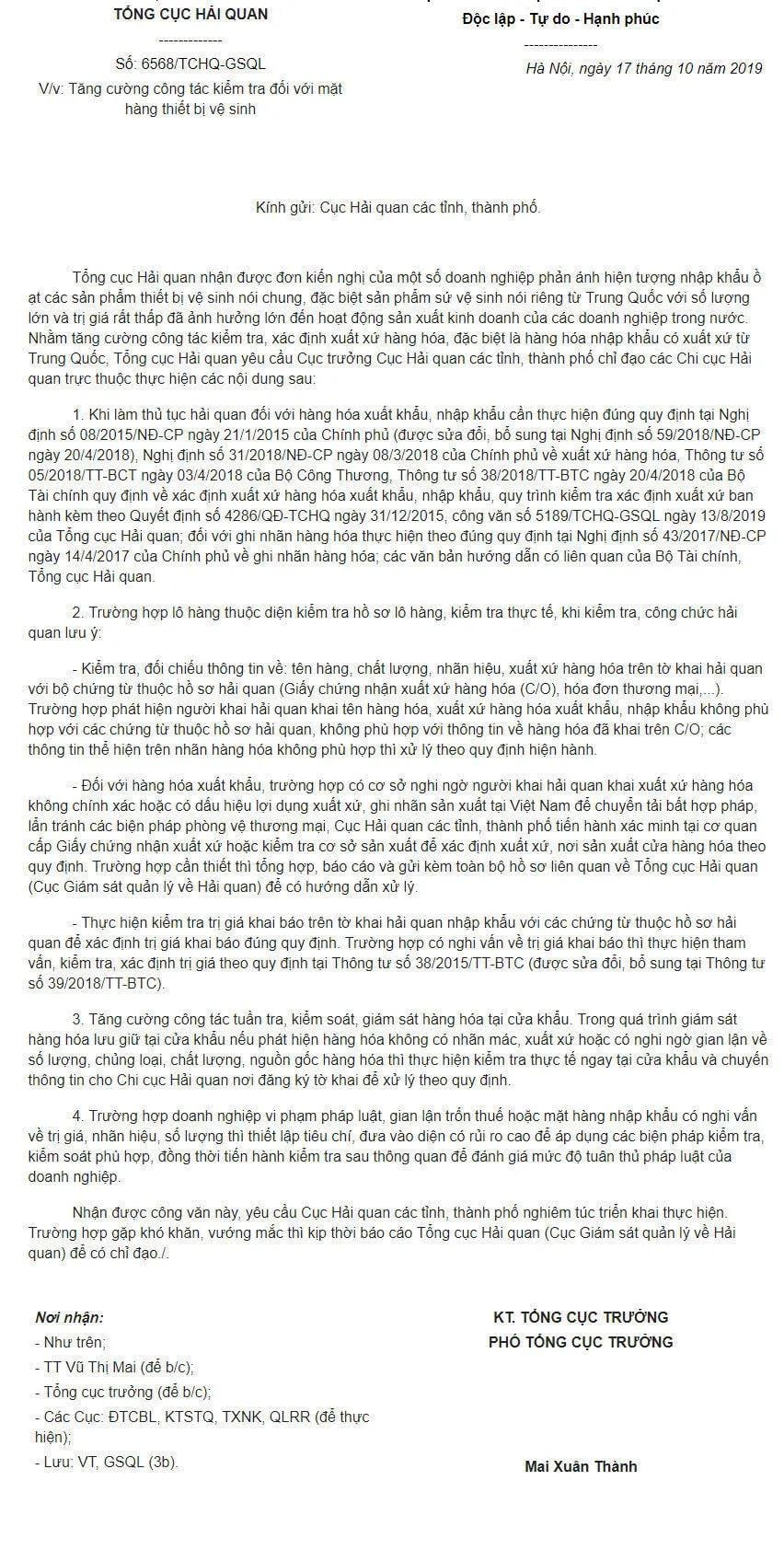
Faktisk, Vietnam had taken precautions against imports of sanitary products from China before the threat was reported in Vietnamese media. I oktober 2019, the Vietnam General Administration of Vietnam Customs issued a document instructing the customs of all provinces and cities to strengthen the inspection of sanitary products, especially those originating in China, and requested all units to strengthen patrol, control and supervision of construction materials at border crossings. The document pointed out that Vietnam Customs has received letters from many enterprises, reflekterer at et stort antall importerte sanitærprodukter, especially those imported from China, har påvirket produksjonen og forretningsaktivitetene til lokale vietnamesiske bedrifter.
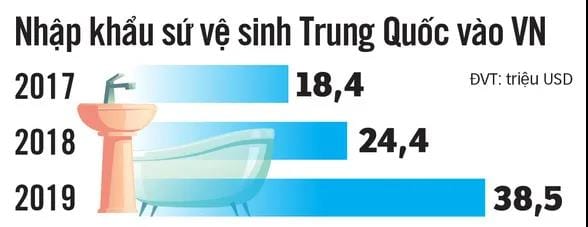
Ifølge statistikk fra Vietnam Customs, Vietnam imported ceramic tiles worth US$100 million and bathroom products worth US$52 million from China in 2019. derimot, det kan være avvik i disse dataene, as the Vietnam Building Ceramics Association revealed that the value of tile products imported from China in 2019 var 200-$250 million, and bathroom products are valued at $110-$120 million.
Vietnam’s attractiveness to sanitary ware companies is manifested in many aspects. Over the past decade, Vietnams BNP har økt med 145.3%. I år, affected by the COVID-19, BNP-veksten forventes å avta til 2.7%, but this is still likely to be the world’s first growth rate. I tillegg, Vietnam’s urbanization process is also proceeding at a high speed. Ifølge myndighetene, etter hvert som folketallet øker, Vietnam må bygge om 100 millioner kvadratmeter nye boliger hver måned, which is a rare opportunity for the bathroom or other building materials companies.
For tiden, a large number of domestic sanitary enterprises have set up the Vietnamese market, som for eksempel, JOMO, FLYVNING, SEAGULL, CRW, LOTA International, and Primy have business in Vietnam and neighboring countries. There are also many enterprises that enter the Vietnamese market as OEM. For eksempel, as reported in the “Youth Daily”, these companies produce products in China and sell them to Vietnamese distributors who labeled it and sold it in the local market.
Competition intensifies as international brands increase investment
According to a report from the Joint Market Research, Vietnam’s bathroom and bathroom accessories market is expected to reach $690 million by 2025. For tiden, Vietnam har konsentrert en rekke kjente merker inkludert TOTO, LIXIL, GESSI and CAESAR, and many of them are increasing their market share in the Vietnamese market in recent years.
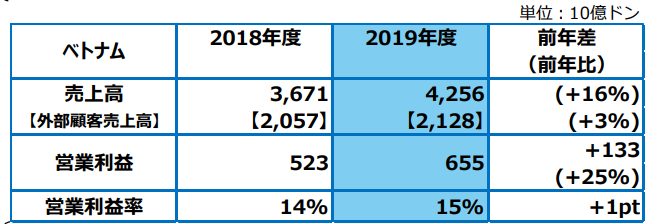
In the part of the TOTO financial report involving the Southeast Asian market, only Vietnam is mentioned separately. I fiskal 2019, TOTO’s sales in the Vietnamese market reached VND 425.6 milliarder (Omtrent RMB 1.3 milliarder), en økning på 16% år til år, og driftsresultatet økte med 25% to VND 655 milliarder (Omtrent RMB 200 million). I tillegg, TOTO announced last year that it will invest JPY 14.6 milliarder (Omtrent RMB 970 million) in Vietnam to build its fourth local factory, which will promote local product sales after it is put into production.
GESSI is an Italian sanitary ware company that pioneered the Vietnamese market earlier, og produktene selges i Vietnam som Vietceramics. I 2018, Gian Luca Gessi, CEO of GESSI and Italy’s Ambassador to Vietnam Cecilia Piccioni attended the opening ceremony of Vietceramics’ 1200 square meters new exhibition hall, showing the importance of the Vietnamese market and reflecting the demand for mid-to-high-end sanitary products in the Vietnamese market are keeping growing.
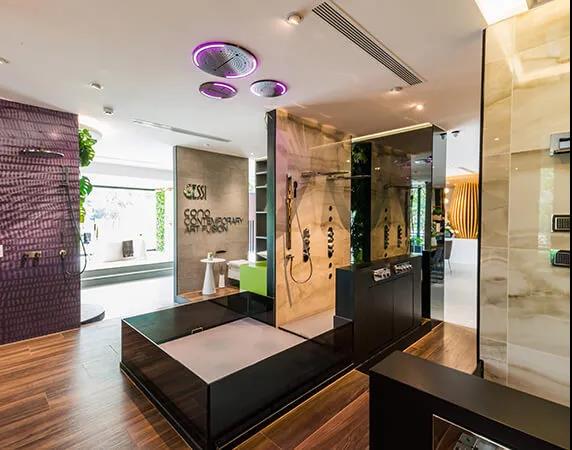
I tillegg til utenlandske merker, as the largest producer of ceramic and sanitary ware products in ASEAN countries,, a number of Vietnamese local brands such as Viglacera, Thien Thanh, Hao Canh, JSC Ceravi, etc. also occupy a significant market share, og har gradvis trengt inn i andre ASEAN-land. Disse lokale selskapene konkurrerer med selskaper fra Kina, Japan, Italy and other countries to form the sanitary industry structure in Vietnam and even Southeast Asia. It is believed that as local residents continue to increase demand for mid-to-high-end products, low-end products will continue to decrease and be replaced by high-spec. competitions among international brands.