 English
 Deutsch
 Français
 Italiano
 Español
 Português
 Nederlands
 Polski
 Русский
 日本語
日本語 한국어
한국어 العربية
 China Faucet Factory & OEM/ODM Faucet Manufacturer
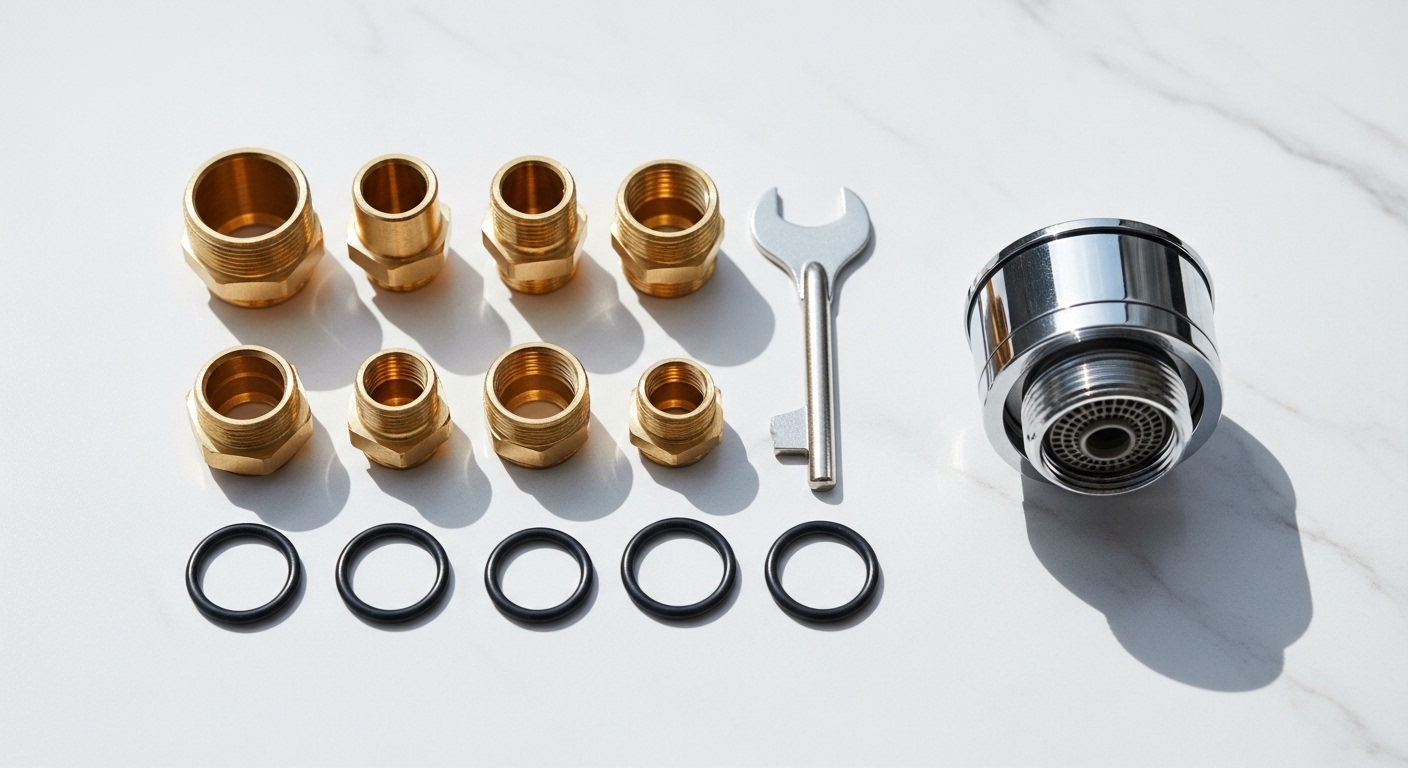
If you’ve ever stood in the aisle squinting at packaging, wondering whether your spout takes a 22 mm female or a 24 mm male thread, a complete faucet aerator adapter kit is the single most useful $15–$30 plumbing upgrade you can make this year. The right kit eliminates leaks, restores splash-free flow, lets you snap on a hand-held sprayer or RO filter in seconds, and saves you from a needless faucet replacement. In this guide, we’ll walk you through every thread standard, every aerator type, what the WaterSense label really means, and how to choose a kit that’s compatible with 95% of household faucets sold in North America.
What Exactly Is a Faucet Aerator Adapter Kit?
A faucet aerator adapter kit is a bundled set of small threaded fittings, washers, and aerator inserts that bridge mismatched faucet outlets to common accessories. The aerator itself is the screen-and-housing assembly at the tip of your spout that mixes air into the water stream to soften flow, reduce splashing, and conserve water. The adapter is what allows that aerator — or a hose, filter, or sprayer — to attach to spouts with non-matching thread sizes.
A typical kit includes:
- Male and female threaded adapters in M22, M24, and 55/64″-27 (the standard U.S. faucet thread).
- Rubber and silicone O-rings or flat washers for a watertight seal.
- Aerator inserts with different flow ratings (typically 1.0, 1.5, or 2.2 GPM).
- A plastic or metal removal key for cache (recessed) aerators that sit flush inside the spout.
- A garden-hose or 3/4″ GHT adapter for connecting laundry hoses, dishwasher fills, or pet shower wands.
Think of the kit as a universal translator between your faucet and the rest of the plumbing world.
Why Buy a Faucet Aerator Adapter Kit Instead of a Single Adapter?
Faucet outlet threads are not standardized worldwide. A French bidet spout, a German imported single-handle, and an American big-box kitchen faucet may all use different thread pitches. Even within the U.S. market, manufacturers freely mix male and female threads on the same product line. Buying a single adapter blind almost always results in a return trip to the hardware store.
A complete adapter kit, on the other hand, hedges your bets. Whether you’re hooking up a portable dishwasher, installing a countertop ice maker, attaching a water-saving aerator on a rental, or running a quick test of pressure-compensating inserts, the kit covers every common scenario. For property managers, RV owners, and homeowners with mixed-vintage fixtures, a single kit is the most efficient purchase.
If you’re still deciding between repair or replacement, our walkthrough on how to change a kitchen tap valve can help you decide whether an aerator swap is the right level of intervention or whether a deeper repair is warranted.
Understanding Faucet Aerator Thread Sizes
Thread compatibility is the #1 reason aerator adapter purchases fail. Here are the three thread standards you’ll encounter on residential faucets:
55/64″-27 (Standard U.S. Imperial)
This is the dominant thread size on North American kitchen and lavatory faucets. The “27” refers to 27 threads per inch. Male-threaded spouts use a 55/64″ outside diameter; female-threaded spouts use a 15/16″ inside diameter. Almost every off-the-shelf aerator sold at U.S. home improvement retailers fits this spec.
M22 × 1 and M24 × 1 (European Metric)
Imported European fixtures — particularly bidet sprays, wall-mount bathroom faucets, and high-end imported single-handle units — almost always use metric M22 (22 mm) or M24 (24 mm) threads. If you’ve bought a Hansgrohe, Grohe, Blanco, or Franke faucet in the past decade, expect metric threading.
Cache and Tom Thumb (Recessed) Aerators
Modern designer faucets often hide the aerator inside the spout for a clean visual line. These “cache” aerators require a special key (usually included in the kit) to install or remove. Sizes range from 16.5 mm to 21.5 mm in male or female configurations.
Comparison Table: Common Aerator Adapter Kit Configurations
| Kit Type | Thread Sizes Covered | Typical Material | Best For | Price Range (USD) |
|---|---|---|---|---|
| Universal U.S. Kit | 55/64″-27 male & female, GHT 3/4″ | Solid brass + chrome | U.S. households, dishwasher hookups | $12 – $20 |
| Metric Imported Kit | M22, M24, M18 male & female | Brass with silicone O-rings | European faucets, bidet sprays | $15 – $28 |
| Pro Multi-Thread Kit | M22, M24, 55/64″, 15/16″, GHT | Lead-free DZR brass | Plumbers, property managers, mixed fixtures | $22 – $40 |
| Cache Aerator Kit | 16.5–21.5 mm recessed + key | Brass with anti-scale screen | Designer/luxury faucets | $18 – $35 |
| Water-Saving Conversion Kit | 55/64″ + 1.0/1.5/2.2 GPM inserts | Brass + polymer aerator core | WaterSense compliance, rentals | $10 – $18 |
What to Look for in a High-Quality Faucet Aerator Adapter Kit
Not all kits are created equal. After 18 years of manufacturing faucets and accessories for North American, European, and Australian markets, we’ve narrowed the buying criteria to seven things that genuinely matter.
1. Solid Lead-Free Brass Body
Look for kits marked “DZR brass” (dezincification-resistant) or “lead-free brass compliant with NSF/ANSI 372.” Plastic adapters strip out within months and can fail catastrophically under hot water. A solid brass body is non-negotiable for any adapter that will see daily use.
2. Silicone (Not Rubber) O-Rings
Silicone O-rings tolerate the 140°F+ temperatures common in modern dishwashers and resist chlorine and chloramine in municipal water. EPDM rubber, while cheaper, hardens within 12–18 months in hot-water applications.
3. A Real Aerator Screen, Not Just a Restrictor
A genuine aerator has a mesh screen that introduces air bubbles into the stream. A flow restrictor merely reduces flow without aeration, producing a hard, splashy stream. Premium kits use multi-stage screens with anti-scale mesh that resists hard-water buildup.
4. WaterSense Compatibility
The EPA WaterSense program certifies lavatory aerators at 1.5 GPM or less and kitchen aerators at 2.2 GPM or less. Look for the WaterSense logo on the packaging if rebates or LEED credits matter to your project.
5. Proper Plating and Finish Matching
If the adapter will be visible (most are, by 2–4 mm), the finish should match your faucet. Common finishes include polished chrome, brushed nickel, matte black, brushed gold, and Champagne bronze. Chrome remains the universal default and is the safest match if you’re unsure.
6. Removal Key Included
If your faucet has a recessed cache aerator, you cannot install or remove it without a plastic or metal key. Confirm the kit includes one in the right diameter for your spout.
7. CSA, NSF, or ACS Certifications
Independent third-party certifications (CSA B125.1, NSF 61, ACS) verify that the brass and rubber components do not leach harmful substances into drinking water. This is the single most important quality signal on the package.
If you’re curious about how high-quality brass adapters are made and why they outperform alloy substitutes, our deep dive on why brass faucets are the best choice for your home explains the metallurgy in plain English.
How to Measure Your Faucet Thread (Before You Buy)
You can save yourself a return trip by measuring before you order. Here’s the simple two-minute procedure:
- Determine male or female. Look up into the spout. If the threads are on the outside of a protruding nozzle, it’s male. If the threads are recessed inside the spout opening, it’s female.
- Measure the diameter. For male threads, measure the outer diameter (OD) across the threads. For female threads, measure the inner diameter (ID) of the spout opening. A digital caliper is ideal, but a metric ruler works.
- Match to standards:
- 15/16″ (≈23.8 mm) ID female → 55/64″-27 standard U.S.
- 55/64″ (≈21.8 mm) OD male → 55/64″-27 standard U.S.
- 22 mm OD male or ID female → M22 metric
- 24 mm OD male or ID female → M24 metric
- Check for recessed/cache style. If you can’t see the aerator screen and the spout opening looks completely smooth, you have a cache aerator and will need the dedicated removal key.
Common Use Cases for a Faucet Aerator Adapter Kit
Connecting a Portable Dishwasher or Washing Machine
Portable dishwashers ship with a quick-connect hose that mates to a garden-hose thread (GHT 3/4″-11.5 NH). Your kitchen faucet does not. The adapter in your kit bridges the kitchen aerator thread to GHT in a single threaded fitting.
Installing an Under-Sink Water Filter or RO System
Many RO systems use a diverter valve that screws onto the faucet aerator thread. If your faucet is metric and the diverter is imperial (or vice versa), the adapter resolves the mismatch instantly.
Adding a Pull-Out Hand-Held Sprayer
Aftermarket hand-held bidet sprayers and pet shower wands typically attach via a 1/2″ or GHT thread. The adapter kit lets you mount these without modifying the faucet itself.
Reducing Splash on a Worn-Out Aerator
If your faucet is splashing badly, the existing aerator is almost certainly clogged with mineral scale. Rather than buying a new $150 faucet, a $15 kit gets you a fresh aerator and a clean, soft stream.
Meeting Rental or Vacation Property Water-Saving Codes
California, Arizona, Colorado, and several other states now require WaterSense-certified aerators in rental properties. A kit with 1.0 and 1.5 GPM inserts gives you instant code compliance.
Installation Step-by-Step
- Shut off the faucet and place a small towel in the sink to catch dropped parts.
- Unscrew the existing aerator counterclockwise. If it’s stuck, wrap a rubber band around it for grip, or use the plastic removal key for cache models.
- Inspect the threads for mineral buildup. A soak in white vinegar dissolves limescale in 15 minutes.
- Slide the O-ring or washer into the new adapter. Skipping this step is the #1 cause of leaks.
- Thread on the adapter by hand only — never use pliers on chrome-plated surfaces, which scratch easily.
- Attach your accessory (aerator, hose, sprayer) to the adapter and snug it gently.
- Turn the water on slowly and check for drips. Hand-tighten an eighth-turn at a time until the leak stops.
For owners replacing a complete faucet rather than just the aerator, our companion guide on how to remove a kitchen faucet walks through the full deck-mount removal procedure.
Material and Finish Options Compared
| Finish | Match Compatibility | Scratch Resistance | Average Lifespan |
|---|---|---|---|
| Polished Chrome | Universal — pairs with almost any faucet | Good (PVD over brass) | 10+ years |
| Brushed Nickel | Pairs with brushed/satin nickel fixtures | Excellent | 10+ years |
| Matte Black | Modern/industrial faucets only | Fair — shows water spots | 5–8 years |
| Brushed Gold/Champagne Bronze | Designer faucets, transitional decor | Excellent (PVD coating) | 10+ years |
| Oil-Rubbed Bronze | Traditional/rustic fixtures | Good (living finish darkens over time) | 8–12 years |
How VIGA Tests Every Adapter Kit Before It Ships
Every adapter in a VIGA aerator kit passes through a four-stage QC protocol before it leaves our Kaiping factory:
- Salt spray testing (ASTM B117): minimum 24 hours for chrome, 48 hours for PVD finishes.
- Pressure cycling: 100,000 on/off cycles at 60 psi, simulating roughly 15 years of household use.
- Thread gauge inspection: every batch is sampled with go/no-go gauges to verify thread tolerance.
- NSF/ANSI 61 water contact certification: confirms zero lead leach from any wetted brass component.
VIGA’s adapter kits carry a 5-year limited warranty against thread failure and finish defects, backed by an ISO 9001:2015 quality management system. We’ve supplied OEM aerator hardware to leading sanitary ware brands since 2008 and run dedicated tooling for both imperial and metric thread standards on the same production line. To understand how manufacturing precision affects faucet longevity, see how to choose a durable bathroom faucet: 5 key manufacturing processes revealed.
Avoid These Common Buying Mistakes
Buying Plastic Instead of Brass
Plastic adapters cost half as much but strip within 6–12 months under normal use. Hot water accelerates failure. The savings are illusory.
Ignoring the GPM Rating
A 2.2 GPM aerator on a low-pressure rural well system will feel like a trickle. A 1.0 GPM aerator on high municipal pressure will splash. Match the flow rate to your supply pressure.
Mixing Finishes Without Realizing
An adapter typically protrudes 2–4 mm below the spout. A chrome adapter under a matte black faucet is visually jarring. Match the finish or choose a low-profile recessed adapter.
Skipping the O-Ring
The kit always includes washers for a reason. A threaded brass-on-brass connection without a seal will weep, no matter how tight you crank it.
Buying a Kit Without Metric Threads When You Have an Imported Faucet
If you bought any Grohe, Hansgrohe, Blanco, Franke, Axor, Dornbracht, or Kraus faucet manufactured in the past decade, presume metric until you confirm otherwise.
FAQ
What is the standard U.S. faucet aerator thread size?
The standard U.S. faucet aerator thread is 55/64″-27, meaning 55/64-inch outside diameter (for male) or 15/16-inch inside diameter (for female), with 27 threads per inch. Approximately 90% of kitchen and lavatory faucets sold at U.S. big-box retailers use this thread.
Do I need a faucet aerator adapter kit if I just want to replace a worn aerator?
If you’re confident your faucet uses the standard 55/64″-27 thread and you want to keep the same flow rate, a single replacement aerator is sufficient. However, a full kit costs only a few dollars more and gives you flexibility to add a dishwasher hose, water filter, or sprayer in the future without another trip to the store.
Can a faucet aerator adapter kit work with both hot and cold water?
Yes. Quality brass adapters with silicone O-rings are rated for continuous service from 39°F to 180°F (4°C to 82°C), covering the full range of household hot- and cold-water temperatures. Avoid plastic adapters on hot-water faucets, as they can deform.
Will an adapter kit reduce my water pressure?
The adapter itself adds no measurable pressure drop. However, the aerator insert you choose does affect perceived flow. A 1.0 GPM aerator will feel softer than a 2.2 GPM aerator. If you want to maintain stronger flow while still saving water, look for “pressure-compensating” aerators that maintain consistent output across a range of supply pressures.
How often should I replace my faucet aerator?
In areas with hard water (above 7 grains per gallon), expect to clean or replace the aerator every 6–12 months as mineral scale clogs the screen. In soft-water areas, the same aerator can last 3–5 years. Reduced flow, sputtering, or splashing are the telltale signs it’s time for service.
Is a faucet aerator adapter kit compatible with touchless and motion-sensor faucets?
Yes, in most cases. Touchless faucets use the same standard aerator threads as manual faucets. The exception is some commercial-style sensor faucets that integrate the aerator into a sealed cartridge — for those, check the manufacturer’s spec sheet before ordering.
Can I use a kitchen aerator on a bathroom faucet?
You can, but you shouldn’t. Kitchen aerators allow up to 2.2 GPM, while bathroom aerators are capped at 1.5 GPM under WaterSense. Using a kitchen aerator on a lavatory will cause splashing and wastes water without improving performance.
Author Note & Brand Credibility
This guide was written by the VIGA editorial team in partnership with senior plumbing engineers at our Kaiping, Guangdong manufacturing facility. VIGA Faucet has been designing and producing kitchen and bathroom fixtures since 2008, supplying both private-label OEM clients and our own branded products to more than 80 countries. Our quality lab is accredited to ISO 9001:2015 and ISO 14001:2015 standards, and every product line — from spouts to aerators to adapter kits — is independently tested against ASME A112.18.1, NSF/ANSI 61, and CSA B125.1 before commercial release.
For more on our manufacturing standards, explore why VIGA Faucet Factory stands out as a trusted bathroom fixture partner.
WeChat
Scan the QR Code with WeChat