 English
 Deutsch
 Français
 Italiano
 Español
 Português
 Nederlands
 Polski
 Русский
 日本語
日本語 한국어
한국어 العربية
 China Faucet Factory & OEM/ODM Faucet Manufacturer
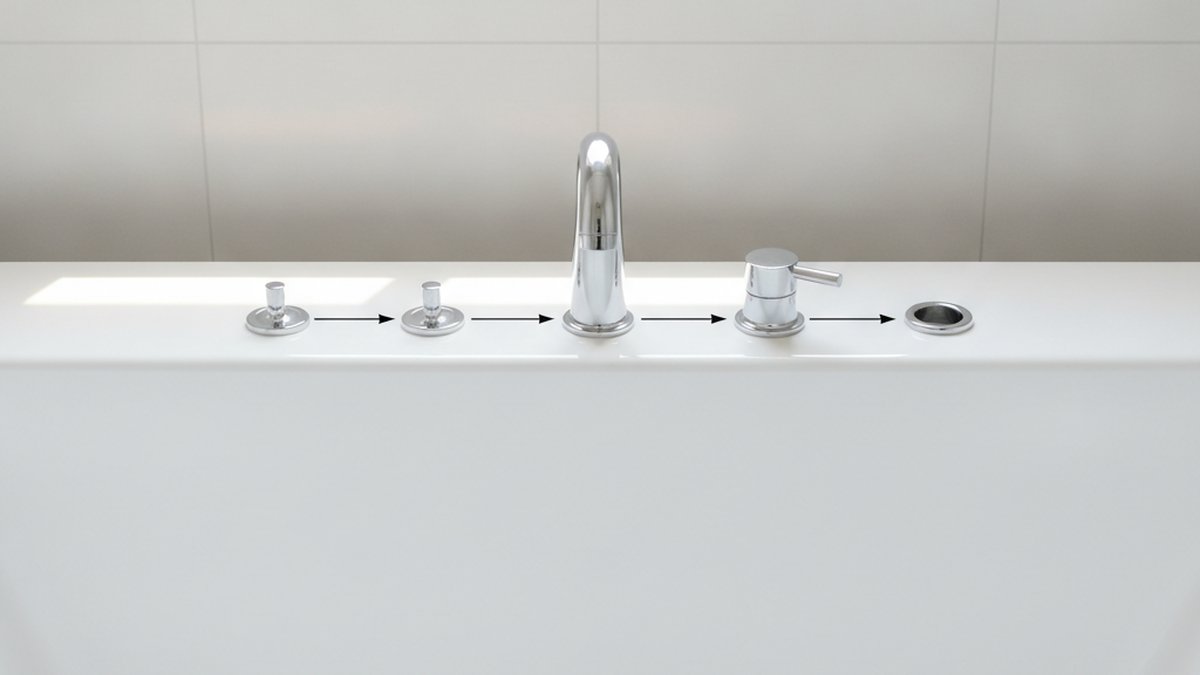
A roman tub faucet with sprayer 4 hole is exactly what it sounds like: a tub filler designed to sit on the flat deck around a drop-in or freestanding-style soaking tub, using four distinct mounting holes instead of one. Three of those holes carry the two handles and the spout, and the fourth holds a handheld sprayer on a flexible hose. It’s one of the most common configurations in American bathrooms built in the last two decades, and if you’re replacing an old set or spec’ing a remodel, matching your deck’s existing hole layout is the single most important thing you’ll do before you buy anything.
Below I’ll walk you through how the 4-hole layout actually works, how to measure so your new faucet fits, whether the sprayer is worth it, what finishes hold up, and the mistakes that send people back to the store. I’ve installed and specified these for both homeowners and hospitality projects, so this is the practical version — not a spec sheet.
What does “4 hole” actually mean on a roman tub faucet?
“4 hole” means your tub deck has four separate drilled openings, and each piece of the faucet mounts into its own hole. This is different from a widespread bathroom sink faucet even though it looks similar, because roman tub valves are bigger, sit lower, and are engineered to move a much higher volume of water to fill a tub fast.
Here’s the standard breakdown of the four holes:
- Hole 1 — Hot handle: Usually the left handle when you face the tub, controlling hot water.
- Hole 2 — Cold handle: The right handle, controlling cold.
- Hole 3 — Spout: The high-arc pour spout, centered between the handles, that fills the tub.
- Hole 4 — Handheld sprayer: A separate hole (often off to one side) holding a pull-out or pull-up handheld wand on a retractable hose.
The two-handle layout is why this is sometimes called a “widespread roman tub filler.” Each handle is an independent valve, so you dial in hot and cold separately rather than using one mixing lever. That’s a preference thing — some people love the precise control and classic look, others miss the one-hand temperature swing of a single-lever design.
How do I know if a 4 hole roman tub faucet will fit my tub?
Measure the center-to-center distance between your existing holes and the diameter of each hole before you buy — that’s the answer, and it prevents 90% of returns. A roman tub faucet with sprayer 4 hole is only “universal” up to a point; the spread between holes has to fall within the range the faucet’s supply lines and mounting hardware can reach.
Grab a tape measure and record three things:
- Hole diameter: Most roman tub decks use holes around 1-3/8″ (about 35 mm), but check yours. Handles and spouts often need a slightly larger hole than a sink faucet.
- Center-to-center spread: Measure from the center of the far-left hole to the center of the far-right hole. Common roman tub spreads run from roughly 8″ up to 16″+, and many faucets are adjustable within a band.
- Deck thickness: The mounting shanks and nuts have to clamp through your deck. Thick stone or tiled decks sometimes need extension kits.
If you’re unsure how hole diameter and spread interact — especially on a stone or vessel-style deck — our deep dive on what faucet hole size you actually need covers the measuring logic that applies to tub decks too. The principle is identical: the hole has to clear the shank, and the escutcheon (the trim ring) has to cover any oversizing.
One more reality check: if your tub deck has a different number of holes — say three (no sprayer) or one (single-hole floor filler) — a 4-hole set is not a drop-in match. You’d be drilling or capping holes, which is doable in acrylic but a real project in cultured marble or granite.
Is the handheld sprayer on a roman tub faucet actually worth it?
Yes, for most people — the handheld sprayer is the single most-used feature after the spout itself, because it turns a soaking tub into something you can actually rinse, clean, and bathe kids or pets in. If you’ve ever tried to rinse shampoo out of long hair while leaning over a tub with no shower, you already know the answer.
Here’s where the 4-hole sprayer earns its keep:
- Rinsing hair and bodies: Directed water beats cupping handfuls from the spout.
- Washing kids and pets: A wand you can aim is far easier than a fixed pour.
- Cleaning the tub: Rinsing soap scum and cleaner off the walls takes seconds.
- Filling buckets and watering: The reach of the hose is genuinely handy.
The trade-off is complexity: one more hose, one more diverter, one more potential leak point. The sprayer works through a diverter — you fill the tub through the spout, then pull the trigger or flip a button on the wand to redirect flow to the handheld. Cheap diverters wear out and dribble; a quality ceramic or well-built brass diverter lasts. If you want to understand the moving parts before you buy, the same wear points show up across handheld wands — our guide to the handheld shower head parts worth knowing maps the hose, wand, and diverter anatomy you’ll be dealing with here.
What finish should I pick, and which ones hold up around a tub?
For a wet, high-touch tub deck, brushed/satin nickel and matte black are the most forgiving day-to-day, while polished chrome is the toughest and cheapest to keep looking new. The “best” finish is mostly about water spots, fingerprints, and your décor — but durability differs more than people expect.
| Finish | Look | Water spots / fingerprints | Best for |
|---|---|---|---|
| Polished Chrome | Bright, mirror-like | Shows spots, wipes off easily | Budget builds, easy cleaning, classic style |
| Brushed / Satin Nickel | Warm, soft silver | Hides spots & prints best | Everyday family bathrooms |
| Matte Black | Bold, modern | Hides prints; shows dried mineral spots | Contemporary designs, white/marble decks |
| Oil Rubbed Bronze | Dark, traditional | Hides prints; living finish patinas | Traditional, rustic, warm palettes |
| Brushed Gold / Champagne Bronze | Warm luxe | Hides prints well | Statement bathrooms |
If you’re drawn to that dark, timeless look, it’s worth knowing how oil rubbed bronze ages before you commit — it’s a “living finish” that changes over time, which some people love and some don’t. We broke down whether an oil rubbed bronze color faucet is still worth buying so you know what you’re signing up for. Whatever you choose, make sure all four pieces — both handles, spout, and sprayer — come from the same collection so the finish matches exactly. Mixing finishes across brands almost never lines up.
Can I install a roman tub faucet with sprayer 4 hole myself?
If your deck already has four correctly-spaced holes and you can reach the underside, yes — a confident DIYer can install a roman tub faucet with sprayer 4 hole in a couple of hours; if you have to drill new holes in stone or the plumbing rough-in is wrong, call a pro. The faucet itself isn’t the hard part. Access is.
The typical process looks like this:
- Shut off water at the supply valves and open the old faucet to relieve pressure.
- Remove the old faucet from below — loosen mounting nuts, disconnect supply lines and the sprayer hose.
- Dry-fit the new valves in each hole and confirm the handles, spout, and sprayer all sit where you want them.
- Secure each piece with its mounting nut and washer from underneath, keeping trim straight on top.
- Connect supply lines to hot and cold, and run the sprayer hose to its diverter port.
- Seal where needed and turn the water back on slowly, checking every joint for leaks.
The number one question I get is whether to use plumber’s putty, silicone, or thread tape — and the answer depends on the connection. Deck seals, threaded joints, and slip fittings each want a different sealant, and using the wrong one causes slow leaks that show up weeks later. Before you start, read what to use for tub spout sealing — putty, thread tape, or nothing; the same rules apply to sealing roman tub deck components. The big one: use thread tape (PTFE) on threaded pipe connections, not on compression fittings, and never over-torque plastic diverter housings.
The genuine difficulty is access under a tub deck. If it’s a drop-in tub inside a tiled surround with no access panel, you may be working blind through a small opening, and that’s where a plumber earns the fee. Drilling new holes in cultured marble or granite is also pro territory unless you own the right diamond bits and are calm about cracking a $600 deck.
4 hole vs. other roman tub configurations — which should you buy?
Buy the configuration that matches your existing holes; if you’re building from scratch, a 4-hole set gives you the most function (independent handles plus a sprayer). Here’s how the common layouts stack up so you can match yours quickly.
| Configuration | Holes | What you get | Best when |
|---|---|---|---|
| 4-hole widespread + sprayer | 4 | 2 handles, spout, handheld sprayer | You want max function & already have 4 holes |
| 3-hole widespread | 3 | 2 handles, spout (no sprayer) | Simple soaking tub, no rinsing needs |
| Single-hole deck mount | 1 | One lever, integrated spout | Minimalist decks, tight space |
| Floor-mount freestanding filler | 0 (floor) | Tall spout + handheld off the floor | Freestanding tubs with no deck |
Note the flow rate too. Roman tub fillers are built for volume — many push 12–20+ gallons per minute so a big soaker doesn’t take 20 minutes to fill. That’s dramatically higher than a bathroom sink faucet (capped at 1.2 GPM by federal rule). Tub fillers are exempt from that cap because they fill a vessel rather than run continuously, but always confirm your supply lines and home water pressure can actually deliver the rated flow. A gorgeous filler starved by 1/2″ undersized supply lines fills slowly no matter what the box promises.
How much should I spend, and what separates cheap from good?
Expect to pay roughly $120–$250 for a solid mid-range roman tub faucet with sprayer 4 hole, $250–$600+ for premium brands and finishes, and under $100 only if you accept lighter materials and shorter-lived diverters. Price mostly tracks the guts you can’t see.
What actually separates a faucet that lasts 15 years from one that leaks in 18 months:
- Valve type: Ceramic disc cartridges outlast rubber-washer/compression valves by a wide margin and drip far less.
- Body material: Solid brass bodies beat zinc-alloy (pot metal) for corrosion resistance and durability.
- Diverter quality: The sprayer diverter is the most common failure point — a good one is brass or ceramic, not thin plastic.
- Hose & wand: A braided stainless or reinforced nylon hose with a smooth-retracting wand holds up to daily pulls.
- Finish process: PVD-coated finishes resist scratching and tarnish far better than electroplated-only coatings.
Brand reputation matters here, but don’t overpay purely for a name. If you want a reality check on which makers actually deliver at each price tier, real owners weigh in on the bathroom faucet brands Reddit recommends — it’s a useful gut-check against marketing.
Author note & why trust this guide
This guide was written by the Vigafaucet product team, drawing on hands-on installation and specification work across residential remodels and hospitality projects. Vigafaucet is a manufacturer and supplier of faucets and bathroom fixtures, so our roman tub fillers are built with solid brass bodies and ceramic disc cartridges, pressure-tested before shipping, and backed by warranty coverage. Our fixtures are produced to meet recognized plumbing standards (such as cUPC and relevant lead-free requirements for potable-water fittings), and we test diverters and hoses through repeated cycles because the sprayer is the part most likely to be abused. When we tell you the diverter is the weak point, it’s because that’s what we see fail — and what we engineer against.
FAQ
What is the difference between a roman tub faucet and a regular tub spout?
A roman tub faucet is a deck-mounted set that installs into holes on the flat rim around the tub, with separate handles, spout, and often a sprayer. A regular tub spout mounts on the wall and is fed by a valve behind the tile. Roman tub fillers move much more water (12–20+ GPM) to fill deep soaking tubs quickly.
Do all 4-hole roman tub faucets come with a handheld sprayer?
No. The fourth hole exists specifically to hold a sprayer, but some 4-hole decks use it for a separate hand-shower, a body spray, or even a cap if the original faucet didn’t include one. If you’re buying a set labeled “4 hole with sprayer,” confirm the handheld wand and hose are actually included in the box.
Can I install a 4-hole roman tub faucet if my deck only has 3 holes?
Not as a drop-in. You’d need to drill a fourth hole for the sprayer, which is straightforward in acrylic or fiberglass but risky in cultured marble, granite, or tile without the right diamond bit. Many people instead choose a 3-hole set to match their existing deck, or add a separate wall- or deck-mounted hand-shower nearby.
Why does my roman tub sprayer have weak flow or won’t stop dribbling?
Nine times out of ten it’s the diverter. A worn or clogged diverter won’t fully redirect water to the sprayer (weak flow) or won’t fully close it off (dribble from the spout when you spray). Cleaning mineral buildup or replacing the diverter cartridge usually fixes it. Low home water pressure or an undersized supply line can also starve the sprayer.
What size holes do I need for a roman tub faucet with sprayer?
Most roman tub components need holes around 1-3/8″ (about 35 mm) in diameter, though this varies by brand — always check the spec sheet for your specific faucet. Just as important is the center-to-center spread between holes, which must fall within your faucet’s adjustable range. Measure before you buy.
Are roman tub fillers exempt from the 1.2 GPM flow limit?
Yes. Federal maximum flow rules that cap bathroom sink faucets at 1.2 GPM don’t apply to tub fillers, because they fill a vessel rather than run continuously. That’s why a roman tub faucet can legally push far more water — which is exactly what you want when filling a large soaking tub.
WeChat
Scan the QR Code with WeChat