 English
 Deutsch
 Français
 Italiano
 Español
 Português
 Nederlands
 Polski
 Русский
 日本語
日本語 한국어
한국어 العربية
 China Faucet Factory & OEM/ODM Faucet Manufacturer
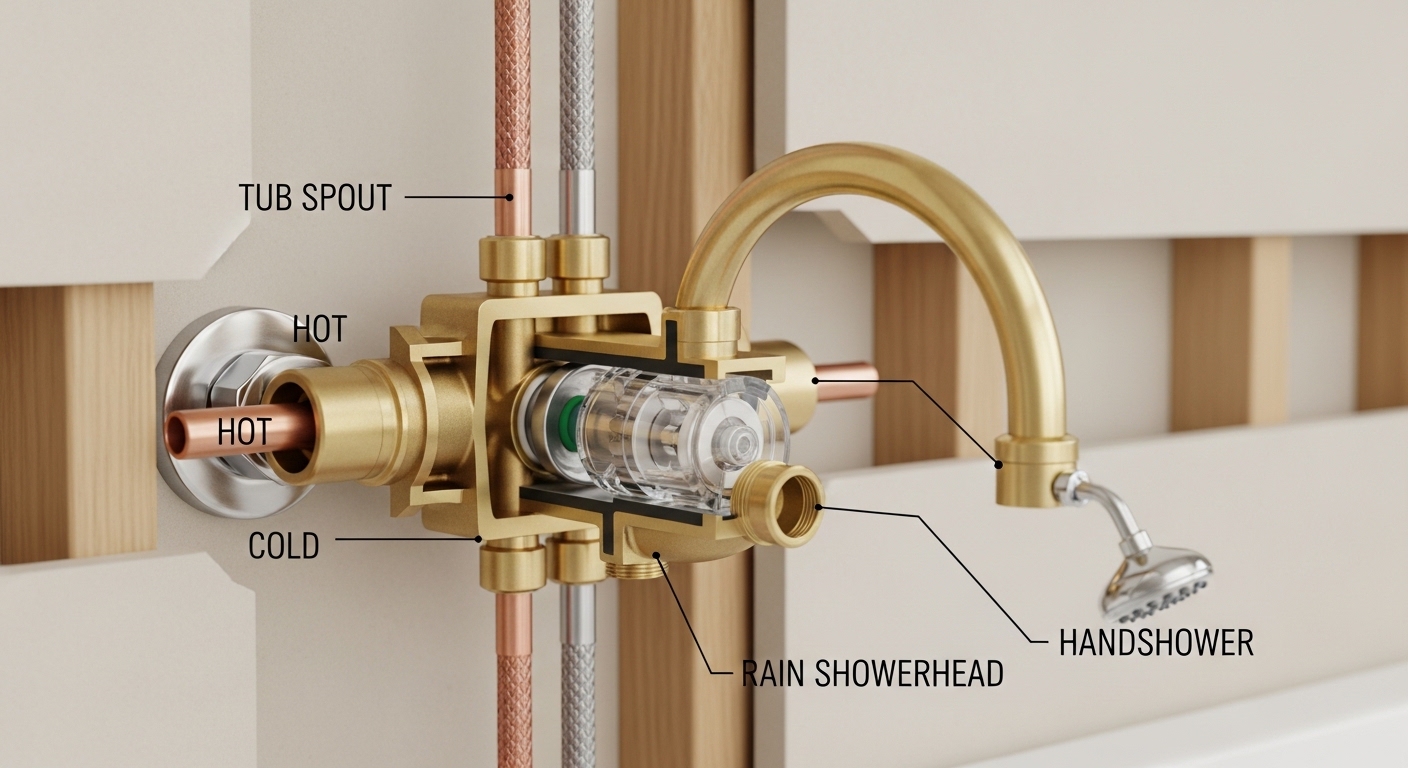
If you’re renovating a tub or shower and the plumber keeps mentioning the “manifold,” here’s the plain-English version: the bathtub faucet manifold is the hidden distribution block that sits inside the wall, behind the pretty handle and spout you actually see. Hot water comes in one side, cold comes in the other, the valve blends them to your set temperature, and the manifold routes that blended water out to each thing you want running — the tub filler, the fixed rain head, a slide-bar handshower, maybe a couple of body sprays. Get the manifold right and everything downstream just works. Get it wrong and you’re opening the wall again. So it’s worth 10 minutes to understand what you’re buying before you commit.
What exactly does a bathtub faucet manifold do?
A manifold does two jobs at once: it mixes hot and cold water to a safe, comfortable temperature, and it distributes that mixed water to multiple outlets. Think of it as the traffic controller of your tub-and-shower plumbing. The mixing part is handled by a cartridge inside the manifold body; the distribution part is handled by the outlet ports cast into that same brass body.
On a simple single-handle tub-shower, the manifold has two outlets — one down to the tub spout and one up to the showerhead — and a diverter (often the little pull tab on the tub spout) decides which one gets the water. On a bigger custom shower, the manifold might have four or five outlets, and you’ll have separate diverter handles or a dedicated diverter valve deciding which outlets are live. The key thing to understand: the manifold and the trim (the visible handles and escutcheon plates) are a matched system. You typically buy the rough-in valve/manifold first, then choose trim that fits it.
This is also why a manifold is a “buy once, cry once” part. The trim is easy to swap later for a finish update. The manifold is buried in the wall behind tile and cement board, so you want it right the first time — correctly sized, pressure-balanced or thermostatic, and from a line that still sells cartridges ten years from now.
Do I even need a separate manifold for a normal single tub-shower?
Short answer: for a basic one-spout, one-showerhead tub-shower, the manifold is built into the pressure-balance valve body — you don’t buy a separate distribution manifold. You only need a dedicated multi-port manifold once you’re feeding three or more outlets, like a rain head plus a handshower plus body jets, or a tub filler plus two shower functions.
Here’s the practical dividing line most homeowners hit:
- 1–2 outlets (tub spout + one showerhead): A standard pressure-balance tub-shower valve has the mixing and the two ports built in. No separate manifold needed.
- 3 outlets (tub spout + rain head + handshower): You’ll want a thermostatic valve with an integrated diverter, or a mixing valve paired with a small distribution manifold.
- 4+ outlets (add body sprays, a second shower zone, or a ceiling head): Now you genuinely need a dedicated manifold — often a thermostatic manifold with a multi-function diverter — because a single valve can’t cleanly split that much flow.
A quick reality check before you go big: your outlets can only run as strong as your incoming water supply allows. If you want a rain head and body sprays running together, you need the gallons-per-minute to feed them. We dig into that trade-off in our guide on how to nail a shower system design that fits your bathroom and budget — read it before you spec a 5-outlet manifold on a house with modest water pressure.
Pressure-balance vs. thermostatic manifold — which one is right for my bathroom?
Choose a pressure-balance manifold for a simple, budget-friendly tub-shower, and a thermostatic manifold when you have multiple outlets or want precise, repeatable temperature control. The difference is real and worth understanding because it affects both comfort and price.
A pressure-balance valve reacts to changes in pressure — when someone flushes a toilet, it keeps your shower from scalding by adjusting the hot/cold ratio to hold roughly the same temperature. It does not let you dial in an exact number; you find your sweet spot by feel each time. It’s the industry standard for code-compliant anti-scald protection and it’s affordable.
A thermostatic valve holds a temperature you set — say 104°F — regardless of pressure or incoming temperature swings, and it can supply higher volume to run multiple outlets at once. This is what you want for a spa-style setup with a rain head plus handshower plus body sprays. It costs more, but for a multi-outlet manifold it’s usually the correct call.
| Feature | Pressure-Balance Manifold | Thermostatic Manifold |
|---|---|---|
| Best for | Simple tub-shower, 1–2 outlets | Multi-outlet / spa shower, 3–5 outlets |
| Temperature control | By feel; holds ratio during pressure changes | Set an exact temperature; holds it precisely |
| Run multiple outlets at once | Limited — usually one at a time | Yes, designed for simultaneous use |
| Anti-scald protection | Yes (ASSE 1016 compliant) | Yes (ASSE 1016 / 1017) |
| Typical price range (valve body) | $60–$180 | $180–$500+ |
| Body material to insist on | Solid brass | Solid brass, forged |
How many outlets and what size manifold should I actually buy?
Count every water outlet you want, add the diverter, and buy a manifold with at least that many ports — never fewer, and one spare port is a smart buffer. Map it on paper before you shop. Walk the shower in your head: reach in, turn it on, what runs?
Here’s a simple way to spec it:
- List every outlet: tub filler spout, fixed showerhead/rain head, handshower, ceiling head, left body sprays, right body sprays. Each is one port.
- Decide what runs together: If rain head and handshower run at the same time, that’s a shared-function diverter position. If everything runs independently, you need more diverter positions.
- Match the diverter: A 2-way diverter switches between two functions; a 3-way or 4-way diverter cycles through more. The manifold’s diverter must match your outlet count.
- Check inlet size: Most residential manifolds use 1/2″ NPT or 3/4″ inlets. Bigger showers with body sprays often need 3/4″ inlets to feed enough volume.
- Confirm rough-in depth: The manifold has to sit at the correct depth in the wall so the trim seats flush against finished tile.
That last point trips people up constantly. If the valve sits too deep or too proud, the escutcheon won’t seal and the handle won’t reach the cartridge stem. It’s the same discipline you use when setting a shower valve height, which we cover in detail in what the right shower valve rough-in height is and where you should set it. Rough the manifold in at the right depth and height together, and installation day goes smoothly.
What should a good bathtub faucet manifold be made of — and how do I avoid a leaky one?
Insist on a solid, forged brass body with a ceramic-disc or high-grade cartridge and quality O-rings — that combination is what separates a manifold that lasts 15+ years from one that weeps at the joints in two. The body material is non-negotiable. Cheap manifolds use thin cast brass or, worse, zinc alloy that corrodes and cracks under thermal cycling. When it fails, it’s inside your wall.
What to look for, in order of importance:
- Forged brass body: Denser and stronger than cast; resists corrosion and handles hot/cold cycling for decades.
- Ceramic-disc cartridge: The mixing heart of the manifold. Ceramic discs seal without wearing out rubber washers, so they don’t drip.
- Serviceable from the front: You want to replace the cartridge without opening the wall. Confirm the cartridge pulls out through the trim opening.
- Available replacement parts: Buy into a line that stocks cartridges and O-ring kits. A manifold you can’t get parts for is a future demolition project.
- Integrated stops: Built-in service stops (screwdriver shut-offs at the manifold) let you service the valve without killing water to the whole house.
Leaks almost always come from three places: a dried-out cartridge O-ring, an over-tightened or cross-threaded outlet fitting, or a hairline crack in a low-quality body. The first is a cheap fix. The last two you prevent at purchase and install. Use thread sealant correctly, don’t gorilla-tighten fittings, and pressure-test the manifold before you close the wall. If you’re the kind of DIYer who’s already handled cartridge work — like a Fresca faucet cartridge replacement — a front-serviceable manifold cartridge will feel familiar.
Can I match a manifold to a freestanding tub or a floor-mount filler?
Yes — but the manifold logic changes because a freestanding tub often uses a floor-mounted filler with its own supply, so your wall manifold may only handle the shower functions. This is one of the most common points of confusion in modern bathroom builds, where a standalone soaking tub sits away from the wall.
Two common setups:
- Floor-mount tub filler + separate shower: The freestanding filler runs off its own valve at the floor; the shower uses a wall manifold. They’re independent systems.
- Wall manifold feeding both tub spout and shower: Traditional tub-shower combos where one manifold routes to a wall-mounted tub spout and the showerhead above.
If you’re going the standalone route, the filler you pick matters as much as the manifold. Our guide on which freestanding tub faucet and shower to buy for a standalone bathtub in 2026 walks through how to pair the floor filler and shower valve so the temperatures and flow feel consistent between them. And if your build routes plumbing on an exterior or exposed wall, read whether a shower system outside-wall setup is right for your bathroom before you set the manifold depth — exposed and outside-wall installs change how the manifold is mounted and insulated.
How much should I budget, and where does vigafaucet fit in?
Plan on $60–$180 for a pressure-balance tub-shower valve body, $180–$500+ for a thermostatic multi-outlet manifold, plus $80–$300 for matching trim depending on finish and brand. The manifold is the part you never see, so it’s tempting to cheap out — resist that. Spend on the body and cartridge; economize, if you must, on the visible trim finish, which is easy to upgrade later.
At vigafaucet, we build tub and shower manifolds around forged brass bodies and ceramic-disc cartridges, with trim options across brushed gold, matte black, chrome, and brushed nickel so you can match the rest of your bathroom without hunting across brands. Because we manufacture the valve body and the trim as a matched system, you avoid the classic mismatch headache where a third-party trim won’t seat on a valve it wasn’t designed for.
Quick answer recap before you buy
- 1–2 outlets: standard pressure-balance valve, manifold is built in.
- 3+ outlets: dedicated manifold, ideally thermostatic.
- Body: forged brass, always.
- Cartridge: ceramic disc, front-serviceable, parts available.
- Rough-in: set depth and height precisely, pressure-test before closing the wall.
FAQ
Is a bathtub faucet manifold the same thing as a shower valve?
Not exactly. A shower valve is the mixing unit that blends hot and cold; a manifold is the body that both mixes and distributes to multiple outlets. On a simple 2-outlet tub-shower, they’re effectively one part. On a multi-outlet system, the manifold is the larger distribution block the valve/cartridge lives inside.
Can I replace just the manifold cartridge without opening the wall?
Usually yes, if you bought a front-serviceable design. The cartridge pulls out through the trim opening once you remove the handle and escutcreon plate. Shut off water at the manifold’s built-in stops (or the house main), pull the old cartridge, and drop in the identical replacement. If your manifold isn’t front-serviceable, that’s a sign it was a lower-quality unit.
How many outlets can one bathtub faucet manifold handle?
Residential manifolds typically handle 2 to 5 outlets. Beyond that, or when you want several outlets running simultaneously at full pressure, you’ll need a thermostatic manifold plus enough incoming water supply (GPM) to feed them all. Counting outlets first and confirming your water pressure second is the correct order.
Will a vigafaucet manifold work with another brand’s trim?
We design our manifolds and trim as a matched system for a reason — mixing brands is where leaks and seating problems start. We recommend pairing our valve bodies with our trim so the cartridge stem length, escutcheon, and mounting depth all line up. If you’re set on another brand’s trim, confirm compatibility before you rough in.
What standards and warranty should a good manifold meet?
Look for anti-scald compliance to ASSE 1016 (pressure-balance) or ASSE 1017 (thermostatic mixing), and a solid warranty on the body and cartridge. Reputable manifolds are pressure-tested at the factory. Vigafaucet backs its valve bodies with a multi-year warranty and stocks replacement cartridges, so a worn part is a five-minute fix rather than a wall demolition — the same “keep the parts available” logic we cover in our piece on the Delta faucet cartridge replacement warranty.
Do I need a plumber to install a manifold, or can I DIY it?
Roughing in a manifold involves soldered or pressed supply connections inside a wall, so most homeowners hire a licensed plumber for the rough-in and handle the trim themselves. If you’re comfortable with sweating copper or PEX connections and pressure-testing, a straightforward 2-outlet manifold is DIY-able. Multi-outlet thermostatic manifolds with body sprays are best left to a pro.
About the author: This guide was written by the vigafaucet product content team and reviewed by our in-house faucet engineers, who spec and pressure-test tub and shower valve bodies for a living. Vigafaucet has manufactured and shipped faucets and shower systems worldwide for over a decade; every manifold we sell uses a forged brass body and a ceramic-disc cartridge, is tested against ASSE anti-scald standards, and is backed by a replacement-parts program so your fixture stays serviceable for years.
WeChat
Scan the QR Code with WeChat