 English
 Deutsch
 Français
 Italiano
 Español
 Português
 Nederlands
 Polski
 Русский
 日本語
日本語 한국어
한국어 العربية
 China Faucet Factory & OEM/ODM Faucet Manufacturer
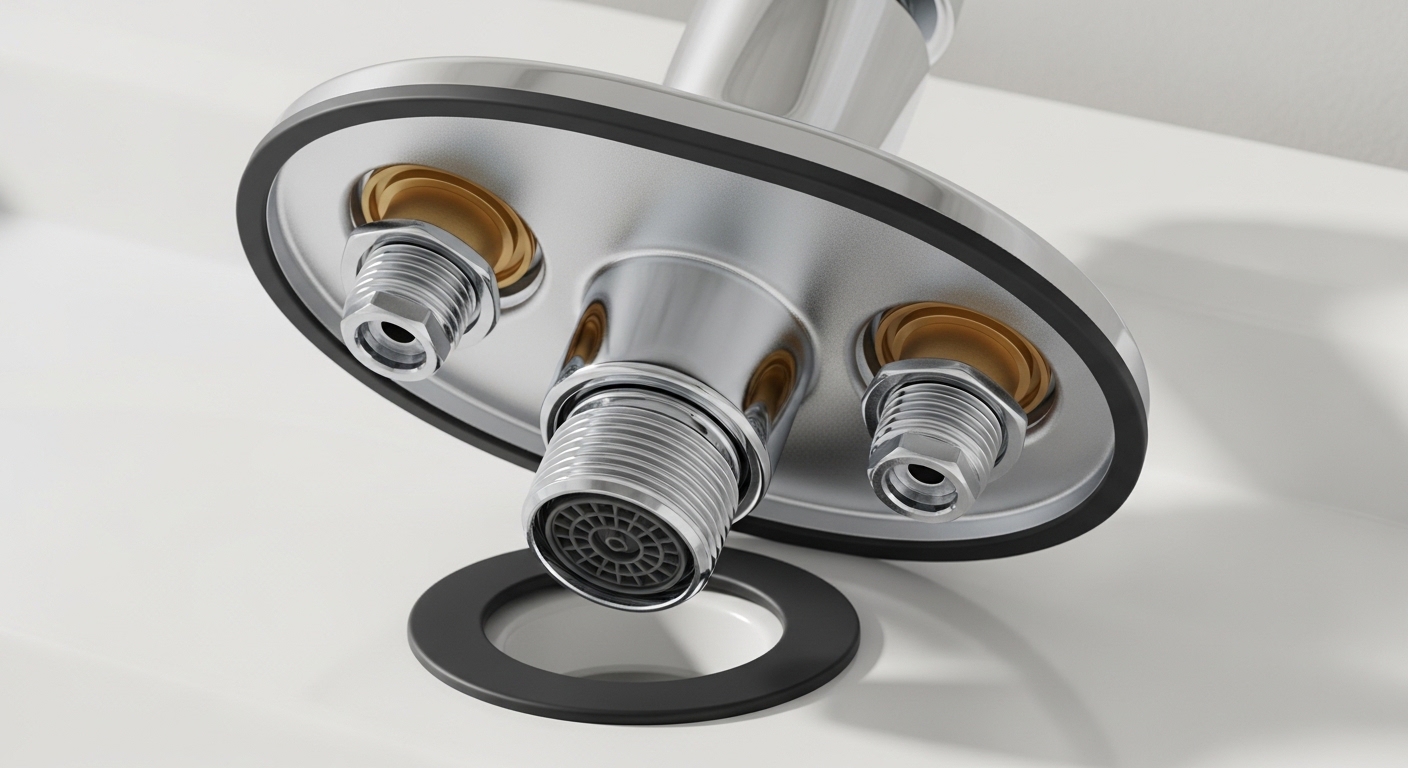
If you’ve ever pulled up a bathroom faucet and found a soggy, crumbling ring underneath, you’ve met the centerset faucet gasket — the unsung part that keeps splash water and drips from creeping under the faucet and rotting your countertop. It’s a small, cheap piece, but the wrong one (or a missing one) is exactly why a two-year-old faucet starts to wobble, smell musty, or leave a water stain around the base. This guide explains what the gasket actually does, how to figure out which one your faucet needs, what material to buy, and when you can skip it entirely and just use putty or silicone.
We’ll keep it strictly practical: sizing, materials, a side-by-side comparison, install steps, and the questions people actually ask before they buy. By the end you’ll know exactly what to order and how to seat it so it never leaks.
What exactly is a centerset faucet gasket, and what does it seal?
A centerset faucet gasket is a flat, pre-shaped seal — usually rubber, foam, or silicone — that fits between the base of a centerset faucet and the top of the sink or countertop. Its whole job is to close the gap around the faucet’s mounting shanks so surface water can’t travel down into the holes, under the base plate, and into the cabinet or countertop core.
“Centerset” refers to a specific faucet style. On a centerset faucet, the spout and the two handles are combined on a single base, and the outer mounting holes are 4 inches apart, measured center-to-center. That base sits on a three-hole sink (two outer holes for the handles/shanks, one center hole for the spout or drain linkage), though many centerset units use the outer two holes plus the center. Because the base is one continuous piece, the gasket is typically one continuous shaped ring or oval that follows the base footprint — not two or three separate washers like you’d see on a widespread faucet.
Don’t confuse the base gasket with the smaller sealing washers that live on each individual shank under the deck. Those shank washers (often a rubber or fiber washer plus a metal locknut) seal each mounting hole from below. The base gasket seals the top side, around the whole footprint. A well-designed faucet uses both, and knowing which one is failing tells you which part to buy. If your leak shows up as water pooling on top of the deck around the base, that’s the base gasket. If water is dripping down inside the cabinet with a dry deck, suspect the shank washers or the supply-line connections instead.
How do I know what size centerset faucet gasket I need?
Start with the golden number: centerset faucets are built for 4-inch center-to-center hole spacing, so the gasket is sized to span that 4-inch layout and cover the base footprint. Measure from the center of one outer mounting hole to the center of the other — if it’s 4 inches, you have a centerset (or “minispread”) layout and need a centerset-style gasket, not a widespread (8-inch) or single-hole one.
Beyond the 4-inch spacing, check three things before you buy:
- Base footprint shape. Centerset bases are usually oval or rectangular. The gasket should match that outline so it fully covers the deck under the base with a little margin, not stick out past the metal.
- Overall length and width. Measure the base plate itself. Most 4-inch centerset bases run roughly 5.5 to 7 inches long and 2 to 3 inches wide. A gasket that’s slightly larger than the base is fine — you’ll trim it or hide it; one that’s smaller leaves a gap.
- Shank hole layout. The gasket has cutouts for the two shanks (and sometimes the center spout tailpiece). Those holes need to line up with your faucet’s shanks, spaced for the 4-inch layout.
The easiest and most reliable move is to buy the gasket that’s made for your specific faucet model — most brands sell it as a repair part, and it’ll match the footprint exactly. If you’re replacing the whole faucet, the new one almost always ships with the correct gasket in the box. You only shop for a gasket separately when the original is torn, missing, or dried out and you’re keeping the existing faucet. For getting the hole layout right in the first place, our guide on what faucet hole size a bathroom sink needs and how to measure it walks through the exact measurements.
Rubber, silicone, or foam — which gasket material lasts longest?
For durability, go with EPDM rubber or silicone; skip cheap open-cell foam if you can. EPDM and silicone stay flexible for years, resist heat and cleaning chemicals, and don’t compress into a permanent flat cookie the way foam does. Foam gaskets seal fine on day one but tend to crumble and lose their spring after a couple of years of moisture cycles, which is why so many old faucets have that disintegrated ring underneath.
Here’s how the common options stack up:
| Material | Typical lifespan | Best for | Watch out for |
|---|---|---|---|
| EPDM rubber | 10+ years | Everyday bathroom faucets; resists water, mild cleaners, temperature swings | Not much — the workhorse choice |
| Silicone | 10+ years | Uneven or textured decks; conforms well and stays soft | Slightly pricier; can slide before the nuts are tightened |
| Closed-cell foam | 3–6 years | OEM budget faucets; fine as a factory part | Compresses over time; replace when it flattens |
| Open-cell foam | 1–3 years | Almost nothing — avoid if you have a choice | Absorbs water, crumbles, breeds musty smell |
| Plumber’s putty (no gasket) | 5–8 years | Metal/solid base plates without a molded gasket channel | Don’t use on natural stone — it can stain |
One material note that trips people up: don’t use plumber’s putty on natural stone, quartz, or certain solid-surface tops — the oils can leave a dark halo. On those surfaces use a clear 100% silicone sealant instead, or rely on the molded gasket alone. On standard porcelain, enameled steel, or stainless sinks, putty is perfectly fine and easy to work with.
Do I even need a gasket, or can I just use silicone or plumber’s putty?
It depends on your faucet’s base design. If your faucet has a solid metal or plastic base plate with a flat bottom, you can often skip a molded gasket and seal it with a thin bead of plumber’s putty or clear silicone instead. If the base has a recessed channel or a factory gasket that seats into it, use the gasket — the base was engineered to seal that way, and putty alone may not fill the gap correctly.
Quick way to decide:
- Flip the faucet over. If there’s a molded rubber/foam ring already glued or seated into the base, that’s your gasket — reuse it if it’s intact, or buy the replacement.
- If the base bottom is bare, flat metal or plastic, a rope of plumber’s putty (on non-porous, stone-free surfaces) or a bead of silicone will seal it just fine.
- If the base is bare AND the deck is stone/quartz, use clear silicone, not putty.
Either way, the goal is the same: a continuous, unbroken seal all the way around the base with no gaps where water can sneak in. Many plumbers actually add a thin ring of silicone on top of a foam gasket for belt-and-suspenders insurance in high-splash bathrooms and kitchens. It’s cheap protection against the slow, hidden leak that ruins a vanity top.
How do you install a centerset faucet gasket so it doesn’t leak?
Set the gasket dry (no putty needed under a proper gasket), align it to the shanks, drop the faucet into the holes, and tighten the mounting nuts evenly from below until the base pulls down snug and the gasket compresses slightly. That even, moderate compression — not brute force — is what creates the seal. Here’s the full sequence:
- Clean the deck. Wipe the sink surface totally dry and remove any old putty, silicone, or crumbled gasket. A clean surface is half the seal.
- Seat the gasket on the faucet base. Line up the cutouts with the shanks and center tailpiece so it sits flat with no bunching.
- Lower the faucet into the holes. Feed the shanks and supply lines through, keeping the gasket in position.
- Add washers and mounting nuts from below. Thread the plastic/metal washers and locknuts up each shank by hand first.
- Tighten evenly, side to side. Snug one nut, then the other, alternating so the base pulls down level. Stop when the base is firm and the gasket shows a slight squeeze — over-tightening can distort a metal base or split a plastic one.
- Wipe any squeeze-out. If you added silicone or putty, clean the excess before it sets.
- Connect supplies and test. Hook up the supply lines, turn the water on, and run both handles while watching the base and the connections underneath for any weeping.
If you’re taking the old faucet out first, do it carefully so you don’t crack the sink or strip the shanks — our step-by-step on doing a bathroom faucet removal the right way covers the tools and the order of operations. And if you notice the base wobbles even after tightening, that’s usually a sign the gasket is too thin, torn, or the wrong footprint — not a reason to keep cranking the nuts.
Why is my centerset faucet leaking around the base — is the gasket to blame?
If water pools on top of the sink around the faucet base, a failed or missing base gasket is the most likely culprit. When the gasket dries out, tears, or was never fully compressed, splash water works its way under the base and reappears as a ring of moisture — or drips into the cabinet with the deck staying wet up top. The fix is to pull the faucet, replace the gasket (or re-seal with silicone), and re-tighten evenly.
But not every “leak around the base” is the gasket. Run through this quick triage before you buy a part:
- Water on top of the deck, base feels loose: base gasket failed or nuts backed off. Replace/re-seal and re-tighten.
- Water only inside the cabinet, deck stays dry: suspect the shank washers, the supply-line connections, or the drain — not the base gasket.
- Water weeping from the spout base or handle, not the deck: that’s an internal cartridge or O-ring issue, a different repair entirely.
- Mineral crust building where water sits: hard water can accelerate seal wear and hide small leaks; keeping the area clean helps you spot problems early.
If hard water is part of your world, it’s worth knowing how deposits attack seals and finishes over time — the same minerals that leave spots also stiffen rubber. Our guide on cleaning hard water stains on a faucet and keeping them from coming back pairs well with a gasket swap if you’re already doing maintenance. For picking a reliable replacement faucet altogether, the community-sourced rundown of bathroom faucet brands Reddit actually recommends is a useful sanity check on build quality — better seals usually come with better faucets.
Centerset vs. widespread vs. single-hole: does the gasket differ?
Yes — the gasket follows the faucet layout, so a centerset gasket won’t fit a widespread or single-hole faucet. Centerset uses one continuous base gasket sized for 4-inch spacing; widespread uses separate seals for the independent spout and two handles; single-hole uses one round gasket or a base plate (“escutcheon”) seal. Buying the wrong style is the most common ordering mistake, so confirm your layout first.
| Faucet type | Hole spacing | Gasket style | Notes |
|---|---|---|---|
| Centerset | 4 in. center-to-center | One continuous base gasket (oval/rectangular) | Spout + handles on one base; most common in small baths |
| Widespread | 8–16 in. adjustable | Separate seals per piece (spout + 2 handles) | Three independent parts; each has its own washer/gasket |
| Single-hole | 1 hole | One round base gasket, optional deck plate seal | Add an escutcheon to cover a 3-hole sink |
| Minispread | 4 in. center-to-center | Separate seals, but on 4-in. layout | Looks like widespread, fits centerset holes |
The takeaway: measure your center-to-center spacing before you order anything. If it’s 4 inches you’re in centerset (or minispread) territory and want a centerset-style gasket. If it’s 8 inches or adjustable, you have a widespread and need the separate seals instead.
Where should you buy a centerset faucet gasket, and what does quality look like?
Buy the OEM replacement gasket for your exact faucet model when you can — it guarantees the footprint and shank layout match. When you’re sourcing generically, look for EPDM or silicone, a molded (not die-cut foam) ring, and a clean, uniform thickness. At vigafaucet, our centerset faucets ship with a molded EPDM base gasket and matching shank washers already in the box, and we stock the seals as spare parts so a five-dollar gasket never forces you to replace a good faucet.
A few quality tells worth checking:
- Molded, uniform edges — no ragged die-cut lines that leak.
- Slight flexibility with memory — it should spring back when you press it, not stay dented.
- Correct thickness — usually 2–4 mm; too thin won’t fill deck irregularities.
- Clean shank cutouts that line up with your 4-inch spacing.
Author & brand note: This guide was written by the vigafaucet product team, which designs and manufactures bathroom and kitchen faucets and has fitted, tested, and warrantied centerset units across residential and light-commercial projects. Our faucets are built to standard bathroom fixture sealing and lead-safe requirements (the kind of ANSI/NSF-type standards reputable manufacturers test to), and our valve bodies and finishes carry a limited warranty — the gasket and washer seals included. We’ve replaced enough dried-out foam rings to have strong opinions about buying EPDM the first time. When in doubt about your exact model’s seal, contact us at www.vigafaucet.com and we’ll match the part.
FAQ
Are all centerset faucet gaskets the same size?
No. They all share the 4-inch center-to-center hole spacing, but the base footprint — length, width, and shape — varies by faucet model. Always match the gasket to your specific faucet’s base outline and shank layout, ideally by buying the OEM replacement for that model.
Can I reuse the old gasket when reinstalling the same faucet?
Only if it’s still intact, flexible, and springs back when pressed. If it’s torn, flattened, crumbling, or hardened, replace it — a $5 gasket is far cheaper than a stained countertop or a repeat teardown. If you’re removing a faucet you plan to reinstall, inspect the gasket before you commit to reusing it.
What’s the difference between a base gasket and a shank washer?
The base gasket seals the top of the deck around the whole faucet footprint; the shank washers seal each individual mounting hole from underneath, sandwiched by the locknut. A leak on top of the deck points to the base gasket, while a leak inside the cabinet with a dry deck usually points to the shank washers or supply connections.
Should I use plumber’s putty with a centerset faucet gasket?
Usually you don’t need both — a proper molded gasket seals on its own. Use plumber’s putty (on non-stone surfaces) or silicone only when the base is bare flat metal/plastic with no gasket, or as an extra belt-and-suspenders bead in high-splash areas. Never use putty on natural stone or quartz; use clear silicone there instead.
How tight should I make the mounting nuts?
Snug, not gorilla-tight. Tighten the two nuts alternately so the base pulls down level, and stop when the base is firm and the gasket compresses slightly. Over-tightening can crack a plastic base, distort a metal one, or squeeze the gasket out of shape — which actually causes leaks rather than preventing them.
My centerset faucet still wobbles after tightening — what’s wrong?
A persistent wobble after even tightening usually means the gasket is too thin, torn, or the wrong footprint, or the mounting holes are oversized for the shanks. Don’t keep cranking the nuts — pull the faucet, verify you have the right centerset gasket for the footprint, and consider adding a metal mounting bracket or thicker gasket to take up the gap.
WeChat
Scan the QR Code with WeChat