 English
 Deutsch
 Français
 Italiano
 Español
 Português
 Nederlands
 Polski
 Русский
 日本語
日本語 한국어
한국어 العربية
 China Faucet Factory & OEM/ODM Faucet Manufacturer
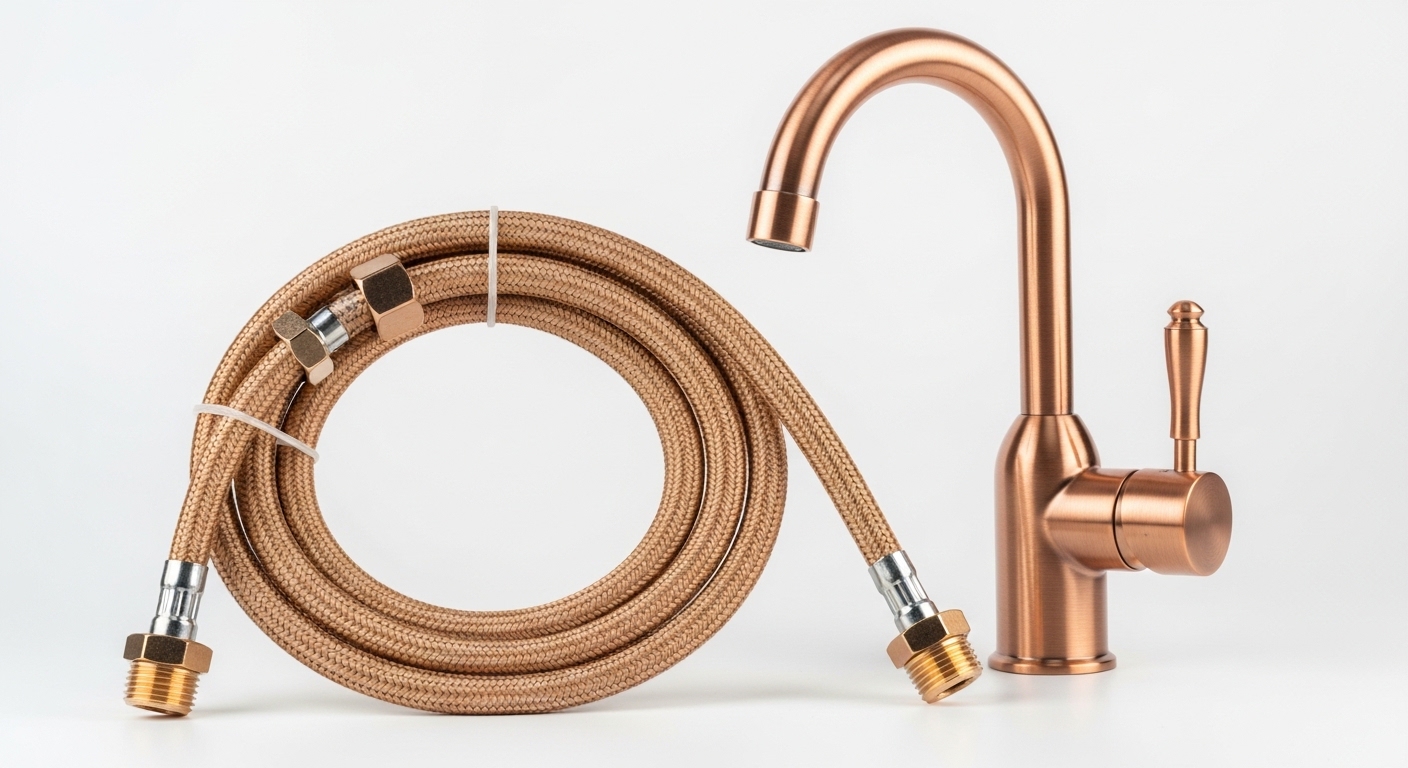
If you’ve been searching for a copper faucet hose, you’re usually looking for one of two things: a flexible supply line that connects your faucet’s tailpiece to the shut-off valve under the sink, or the retractable hose inside a pull-down/pull-out kitchen faucet — either in genuine copper tube or in a warm copper/rose-gold finish that matches a copper or brushed-bronze faucet. This guide sorts out which one you actually need, what to look for, and how to avoid the two mistakes that cause 90% of returns: wrong fitting size and a hose that’s too short.
What exactly is a copper faucet hose — genuine copper or just the finish?
It’s usually the finish, not solid copper. The vast majority of “copper faucet hoses” sold today are braided stainless-steel or braided PEX hoses with copper-colored end fittings, or a copper-toned outer sleeve — designed to match copper, rose-gold, or brushed-bronze faucets. True rigid copper tube supply lines still exist, but they’re mostly used by plumbers who bend and solder them; homeowners almost always want the flexible braided kind because it installs in minutes with no soldering.
So there are really three product categories hiding under one search term:
- Copper-finish braided supply hose — flexible, connects faucet to the wall/floor shut-off valve. This is what most people mean.
- Copper pull-down spray hose — the internal hose in a pull-out or pull-down kitchen faucet, sometimes sold as a replacement part in a matching finish.
- Rigid copper tube / copper riser — a solid copper supply line, usually 3/8″ OD, for a clean exposed look under a wall-mount or vessel sink.
Knowing which of the three you’re buying matters, because the fittings and the way you measure are completely different. A supply hose is measured end-to-end by length and thread size; a pull-down hose is measured by the faucet model it fits.
Which copper faucet hose is right for a standard under-sink connection?
For a standard bathroom or kitchen sink, buy a flexible braided supply hose with a 3/8″ compression connector on the valve end and a 1/2″ IPS (or the size your faucet specifies) on the faucet end — most brands print this on the packaging. That single combination fits the large majority of North American sinks. If your faucet came with captive supply lines already attached (common on cheaper single-hole faucets), you don’t need a separate hose at all — you need an adapter or extension instead.
Here’s the quick decision path:
- Look at your shut-off valve. Most modern angle stops are 3/8″ compression. Older homes may have 1/2″ sweat or threaded.
- Look at your faucet’s inlet. Bathroom faucets are commonly 1/2″ IPS or have a 3/8″ compression tailpiece; kitchen faucets vary more.
- Measure the gap from valve outlet to faucet inlet, then add 4–6 inches of slack so the hose curves gently instead of kinking.
- Match the finish last — the copper look is cosmetic and shouldn’t override getting the fittings right.
If your existing setup looks corroded or you’re pulling an old faucet, do it cleanly — our walkthrough on bathroom faucet removal the right way shows how to disconnect supply lines without cracking the sink or rounding off the nuts.
Copper hose vs. stainless braided vs. PEX — what actually lasts?
For durability, a braided stainless-steel core is the safest all-round pick; solid copper looks best but is more prone to kinking and pinhole corrosion in aggressive water; PEX-lined braided hoses are cheap and fine for low-visibility spots. The “copper” you see is usually the outer jacket or the fittings, so you can get the copper look with a stainless core underneath — the best of both worlds.
| Hose type | Typical lifespan | Best for | Watch out for |
|---|---|---|---|
| Braided stainless (copper-finish jacket) | 8–15 years | Most kitchen & bath supply connections | Cheap versions use thin braid — check the burst rating |
| Solid copper tube / riser | 20+ years (good water) | Exposed wall-mount or vessel sinks, showpiece installs | Kinks if over-bent; pinholes in acidic/hard water |
| Braided PEX (copper sleeve) | 5–10 years | Hidden, budget connections | Not as heat-tolerant on hot side |
| Pull-down spray hose (nylon/PEX) | 5–10 years | Kitchen pull-out faucets | Must match your faucet brand/model |
One thing people underestimate: water chemistry. In hard or acidic water, thin-wall copper can develop pinhole leaks faster than a good stainless braid, and mineral scale builds up inside any hose. If you’re already fighting mineral buildup, it’s worth reading how to clean hard water stains on a faucet and keep them from coming back — the same water that stains the outside is quietly narrowing the inside of your hose.
Does a copper finish on the hose actually corrode?
The finish itself doesn’t fail structurally, but real copper and copper plating will patina over time — that’s the living, darkening look copper lovers actually want. If you prefer it staying bright and shiny, look for a lacquered or PVD copper/rose-gold finish, which resists tarnish far longer than raw copper. Under a sink where nobody sees it, don’t pay extra for finish at all; put the money toward a higher burst rating.
What size and length copper faucet hose should I buy?
Buy the fitting sizes your valve and faucet require, and a length equal to the gap plus about 5 inches of slack. The most common combination is 3/8″ compression (valve side) to 1/2″ IPS/FIP (faucet side), in a 12″, 16″, or 20″ length. Too short and the hose strains the connection; too long and it coils and kinks. When in doubt, size up in length — you can always let a hose curve, but you can’t stretch it.
A few sizing rules that save returns:
- Measure with the faucet in place if possible, or dry-fit before buying. Guessing the gap is the #1 cause of a hose that’s an inch too short.
- Hot and cold are the same length in almost every case — buy a matched pair so they curve symmetrically.
- Check thread type, not just diameter. 1/2″ IPS (tapered pipe thread) and 1/2″ compression are not interchangeable. When a listing just says “1/2 inch,” ask which thread.
- For a pull-down kitchen hose, length is fixed by the faucet — you replace with the exact model part, not a generic hose.
If your search is really about a kitchen sprayer that won’t behave, the hose is often the culprit. See why a faucet sprayer isn’t retracting and how to remove a pull-down spray head without breaking it before you assume you need a whole new faucet.
How do I install a copper faucet supply hose without leaks?
Hand-tighten both ends, then turn a further quarter to half turn with a wrench — no more. Braided supply hoses seal with a rubber cone washer or the compression ferrule, not by brute force, and over-tightening is what cracks fittings and causes the slow drip you’ll discover a week later. Turn the water back on slowly and watch each joint for 60 seconds.
Step by step:
- Shut off both angle stops and open the faucet to release pressure.
- Attach the hose to the faucet inlet first (it’s the tighter space), snug by hand.
- Attach the other end to the shut-off valve. For compression ends, don’t add tape to the ferrule; for IPS/threaded ends, 2–3 wraps of PTFE tape is fine.
- Snug with a wrench — a quarter turn past hand-tight for braided hoses.
- Open the valves slowly. Feel each joint with a dry paper towel; any darkening means re-seat and re-tighten.
- Check again after 24 hours — a hairline weep sometimes only shows under a full day of pressure.
Where should you actually buy a copper faucet hose — and how do you judge quality?
Buy from a plumbing-focused brand or specialist that publishes the burst pressure, certification, and exact thread sizes — not a generic marketplace listing that only shows a color. A trustworthy copper faucet hose lists an NSF/ANSI 61 (drinking-water safe) or equivalent certification, a burst rating well above household pressure, and the precise fittings on both ends. If those specs aren’t stated, treat the price as the only thing you actually know.
Quality checklist before you add to cart:
- Burst/working pressure: household water is typically 40–80 psi; look for a working rating of 125 psi+ and a burst rating several times higher.
- Certification: NSF/ANSI 61 for the wetted materials; low-lead compliance for anything on drinking water.
- Warranty: a real hose or faucet brand backs the part — even a 1–5 year warranty tells you they expect it to last.
- Stated fittings: both ends spelled out (e.g., “3/8″ comp × 1/2″ FIP”), not just “universal.”
- Core material: stainless braid for reliability; be skeptical of a “solid copper” claim at a suspiciously low price.
If you’re sourcing at volume or evaluating an overseas supplier’s spec sheet, it pays to know how the numbers are quoted — our guide on how to read a faucet quotation from China before ordering breaks down which line items (materials, certification, thread standards) actually protect you. And if your project involves a sprayer or high-flow setup, a commercial kitchen faucet adapter may be the fitting you’re missing between the hose and the faucet.
Is a genuine solid copper riser worth the extra money?
Only if the hose will be visible. On an exposed wall-mount, vessel, or console sink where the supply lines show, a polished or aged solid-copper riser looks stunning and reads as high-end. Hidden under a cabinet, it’s money spent on something nobody sees — a copper-finish braided hose delivers the same water for a fraction of the price and won’t kink if you nudge it.
What problems does a bad copper faucet hose cause down the line?
A cheap or wrongly sized hose causes three predictable failures: slow drips at the fittings, restricted flow from internal scale or a partial kink, and — worst case — a burst under pressure that floods the cabinet. Almost all of these trace back to under-rated hoses, over-tightening, or corrosion from bad water. Spend a little more on a certified hose and it becomes a part you forget about for a decade.
Watch for these warning signs on an existing hose:
- Green/white crust at the fittings — corrosion or a slow weep starting.
- Rust-colored water or reduced flow — internal buildup; if it’s coming through the whole system, see why rust is clogging your faucet and how to fix it for good.
- Bulging or blistering braid — the core is failing; replace immediately.
- Stiffness or a permanent kink — the hose is choking flow even if it isn’t leaking yet.
Supply hoses are cheap insurance. Plumbers routinely recommend replacing braided supply lines every 8–10 years even if they look fine, because a $10 hose failing while you’re on vacation is a four-figure water-damage problem.
FAQ
Is a copper faucet hose safe for drinking water?
Yes, if it’s certified. Look for NSF/ANSI 61 certification and low-lead compliance on the fittings — that means the wetted materials are approved for potable water. Copper itself is a traditional, safe plumbing material; the concern is only cheap uncertified alloys or solder, which certification rules out.
Can I use a copper-finish hose with a non-copper faucet?
Absolutely — the hose is almost always hidden under the sink, so its finish is purely cosmetic and doesn’t need to match the faucet at all. The only time finish matters is on an exposed installation like a wall-mount or vessel sink, where a copper riser is part of the look. Underneath a cabinet, buy on fittings and pressure rating, not color.
How long do copper faucet supply hoses last?
A quality braided hose with a copper finish typically lasts 8–15 years, and solid copper tube can last 20+ years in good water. Hard, acidic, or high-pressure water shortens that. Most plumbers suggest proactively swapping braided supply lines around the 8–10 year mark as cheap insurance against a burst.
What’s the difference between a supply hose and the pull-down hose in my kitchen faucet?
A supply hose connects your shut-off valve to the faucet and is sized by thread and length; the pull-down hose is the internal retractable hose inside a spray faucet and is sized by your specific faucet model. You can buy a generic supply hose, but a pull-down replacement should match the faucet brand and model so the weight, quick-connect, and length are correct.
Do I need plumber’s tape (PTFE) on a braided copper hose?
On threaded IPS/FIP ends, yes — 2–3 wraps of PTFE tape help seal the threads. On compression ends that seal with a cone washer or ferrule, no — tape there can actually prevent a proper seal. When in doubt, tape tapered pipe threads and leave compression/rubber-washer connections bare.
My copper hose is dripping at the fitting — did I get a defective one?
Usually not; it’s almost always an over-tightened, under-tightened, or cross-threaded fitting rather than a bad hose. Turn off the water, back the nut off, check the washer is seated and the threads are aligned, then re-tighten to just a quarter-turn past hand-tight. If it still weeps after re-seating, replace the washer before assuming the hose is faulty.
Author note: This guide was written by the VIGA product team, drawing on our experience manufacturing and testing faucets, supply lines, and pull-down hose assemblies for kitchens and bathrooms. About VIGA: vigafaucet.com designs and supplies faucets and fixtures for homeowners, designers, and trade buyers worldwide; our supply components are pressure-tested and built to recognized standards including NSF/ANSI 61 for potable-water contact, and our fixtures are backed by manufacturer warranty. Always confirm the certification, burst rating, and exact fitting sizes on any hose before you install it.
WeChat
Scan the QR Code with WeChat