 VIGA Faucet Manufacturer
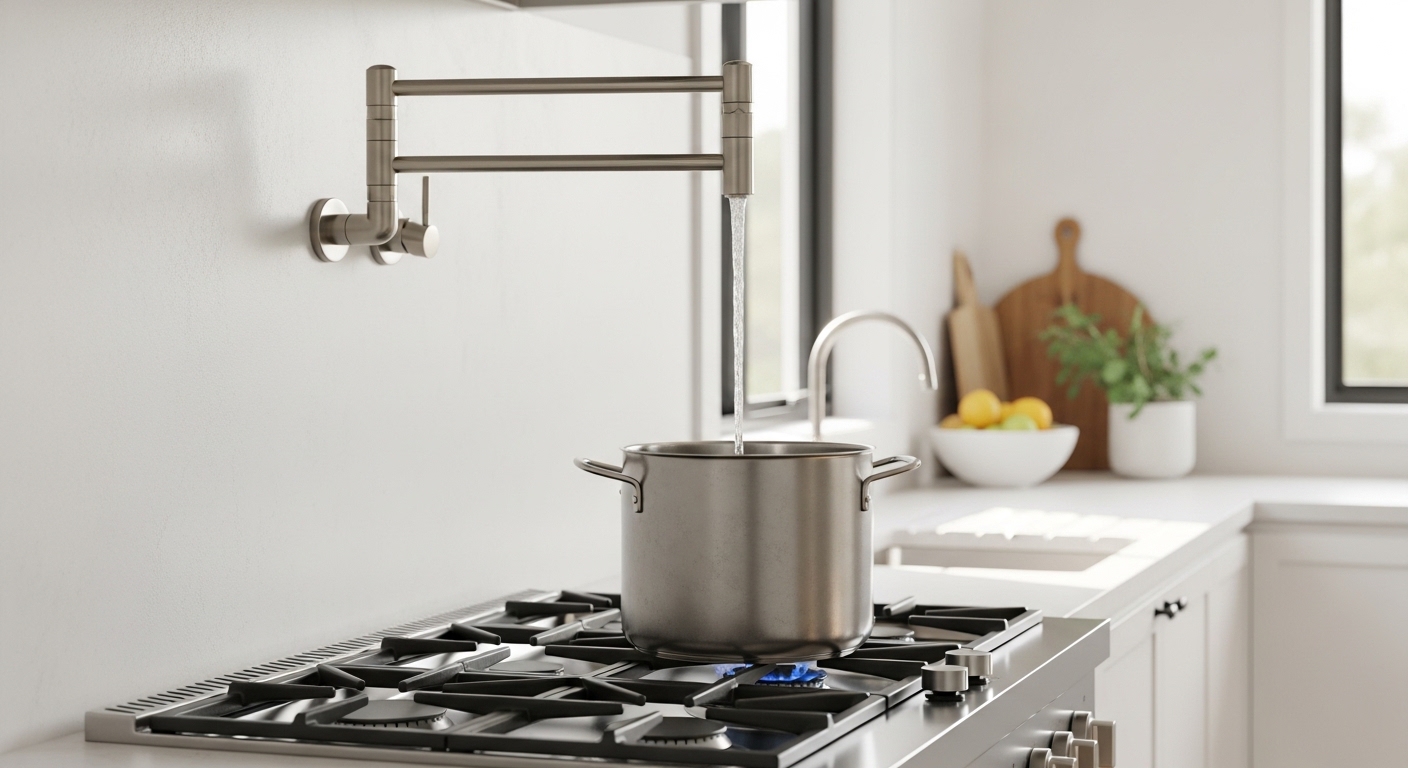
A pot filler tap Australia shoppers actually want is a cold-water-only articulated tap mounted on the wall behind your stove, so you can fill big stockpots right on the burner instead of hauling them from the sink. It sounds like a small luxury — and it is — but the buying decision hinges on three very Australian details that overseas buying guides skip entirely: WaterMark certification, WELS water-efficiency labelling, and getting the mounting height right for your specific cooktop. Get those three right and a pot filler is one of the most satisfying upgrades in a serious kitchen. Get them wrong and you’ve bought a tap that’s illegal to connect, splashes over the pot rim, or won’t pass a plumbing inspection at resale.
This guide answers the real questions people type and ask out loud: are pot fillers legal in Australia, how high should you mount one, do you need hot water, what should you pay, and which type actually holds up. Let’s get into it.
Are pot filler taps legal and compliant in Australia?
Yes — pot filler taps are completely legal in Australia, but the tap itself must carry a WaterMark certification and it must be installed by a licensed plumber. That’s the non-negotiable part. Any tapware permanently connected to the mains water supply in Australia has to be WaterMark-certified to prove it meets AS/NZS 3718 (the standard for water supply tapware). A pot filler is no exception, even though it “just” dispenses cold water.
This is where a lot of imported bargains fall apart. Plenty of pot fillers sold on overseas marketplaces are certified to American ASME/CSA standards or European norms — impressive-looking paperwork that means nothing to an Australian plumbing inspector. If your tap doesn’t carry the WaterMark trademark and a valid licence number, a licensed plumber technically cannot connect it, and it can become a problem at building sale or insurance-claim time. When you’re comparing suppliers — especially direct-from-factory quotes — you need to read the certification line carefully; our guide on how to read a faucet quotation from China before ordering walks through exactly which certifications to demand and which claims to ignore.
The second compliance piece is WELS (Water Efficiency Labelling and Standards). By law, taps sold in Australia must display a WELS star rating and a flow rate in litres per minute. A pot filler doesn’t need to be ultra-low-flow — you actually want decent flow so a 12-litre stockpot fills fast — but it must carry the label. Look for a flow rate around 6–9 L/min, which fills quickly without turning into a fire hose.
Do you need a licensed plumber, or can you DIY it?
You need a licensed plumber for the final mains connection — full stop. In every Australian state and territory, connecting tapware to the potable water supply is licensed plumbing work. You can absolutely do the prep yourself (planning the location, choosing the tap, even rough framing if you’re renovating), but the pipe connection and pressure test must be signed off by a licensed plumber, who issues a Certificate of Compliance. That certificate is what protects you if anything ever leaks inside the wall.
How high should you mount a pot filler tap above the cooktop?
Mount the pot filler so the spout outlet sits roughly 250–350 mm (about 10–14 inches) above the cooktop surface — high enough to clear your tallest stockpot with the lid off, low enough that water doesn’t splash out of the pot. The single most common regret people report is mounting it too low and discovering their 30 cm stockpot won’t fit under the arm.
Here’s the practical way to nail it. Measure your tallest pot standing on the burner, add about 50–75 mm of clearance, and that’s where the folding arm should clear when extended. Because a good pot filler has a double-jointed arm, the outlet drops down toward the pot when you unfold it, so you mount the wall bracket higher than the outlet’s resting position. Most Australian kitchens with a standard 900 mm high benchtop end up with the wall bracket around 1150–1250 mm off the finished floor.
A few scenario-specific notes:
- Induction and ceramic cooktops: the cooking surface is flush, so you get a little more usable height — you can mount slightly lower for less splash.
- Gas cooktops with trivets: remember the pot sits up on the trivet, 30–50 mm above the bench. Account for that or you’ll lose clearance.
- Rangehood clearance: make sure the folded arm doesn’t foul the rangehood or splashback tiles. Fold and unfold a cardboard mock-up before the plumber cuts anything.
- Reach over the back burner: the fully extended arm should reach the centre of the back burners, not just the front. Standard reach is 550–600 mm total across the two joints.
Should you rough in the plumbing during a renovation?
If you’re renovating or building, absolutely rough in the water supply behind the splashback before the tiling goes on — retrofitting later means cutting open a finished wall. The logic is identical to setting any concealed valve position correctly the first time; if you’ve ever dealt with a mis-set concealed fitting, our piece on getting the right rough-in height for a concealed valve explains why measuring twice before the wall closes up saves an expensive redo. For a pot filler, tell your plumber the exact model early, because the required cold-water stub-out position and the mounting plate’s fixing points vary by brand.
Do pot filler taps have hot water, or are they cold only?
Almost every pot filler tap in Australia is cold water only — and that’s by design, not a limitation. You fill the pot with cold water and heat it on the stove, so hot water at the tap would be pointless, and running a hot line up your splashback adds cost and scald risk for zero benefit. A single cold supply is cleaner, cheaper, and easier to rough in.
This puts a pot filler in the same family as other single-supply, cold-only wall taps. If you want to understand the plumbing logic and where a cold-only wall tap genuinely earns its place, our explainer on the wall-mount cold-only faucet covers the mounting and supply details that apply directly to pot fillers too.
One genuinely useful feature to insist on: dual shut-off valves. A quality pot filler has one valve at the wall joint and a second at the spout tip. The double shut-off means you can leave the tap “armed” at the wall and control flow precisely at the outlet, and it gives you a backup seal if one valve ever weeps. Cheaper single-valve models are more prone to drips onto your cooktop over time.
What should you pay for a pot filler tap in Australia?
Expect to pay between AUD $150 and $600 for a WaterMark-certified pot filler tap in Australia, with the sweet spot for a solid brass, dual-valve model landing around $250–$400. Below about $120 you’re almost always looking at uncertified stock, thin zinc-alloy construction, or grey imports that a plumber can’t legally connect. Above $600 you’re paying for premium designer finishes and brand name more than function.
Here’s how the tiers break down in practice:
| Price tier (AUD) | What you typically get | Body material | Best for |
|---|---|---|---|
| $80–$150 | Often uncertified imports, single valve, basic chrome | Zinc alloy or thin brass | Risky — verify WaterMark or avoid |
| $150–$250 | Entry certified, single or dual valve, chrome/brushed nickel | Brass | Budget renovations, rentals |
| $250–$400 | Dual shut-off, ceramic disc cartridges, multiple finishes | Solid brass | Most home kitchens — the sweet spot |
| $400–$600+ | Designer finishes (matte black, gunmetal, brushed gold), premium warranty | Solid forged brass | High-end and display kitchens |
Don’t forget installation. A licensed plumber will usually charge $200–$450 to run the cold stub-out and connect the tap, more if a wall needs opening. Budget for that up front so the final number isn’t a surprise.
Are wall-mounted or deck-mounted pot fillers better?
For Australian kitchens, a wall-mounted pot filler behind the cooktop is almost always the better choice — it keeps the arm up and out of the way, folds flat against the splashback, and reaches over the burners. Deck-mounted pot fillers, which bolt to the benchtop beside the cooktop, exist but eat bench space and are less common here. Choose wall-mounted unless your layout genuinely can’t support a supply line in the wall (for example, a masonry wall you can’t chase).
Which pot filler type and finish holds up best?
A solid brass, double-jointed pot filler with ceramic disc cartridges and a PVD-coated finish (brushed nickel, gunmetal, or matte black) holds up best in Australian conditions. Solid brass resists corrosion far better than zinc alloy, ceramic disc cartridges outlast rubber washers by years, and PVD coatings resist scratching and the mineral spotting that plagues our harder water areas.
The double-jointed (double-articulated) arm matters more than finish. A single-joint arm only swings side to side; a double-jointed arm folds at two points so it extends out over the back burner and then folds completely flat when you’re done, taking up almost no depth against the splashback. If you cook with big pots, the double joint is worth the small premium every time.
On finish and water spotting: much of Australia — Adelaide, parts of Perth, regional areas on bore or tank water — has genuinely hard water, and that mineral content leaves white spots on tapware. A brushed or matte finish hides spotting better than polished chrome, but any finish benefits from a quick wipe after use. If your tap does start showing mineral marks, our guide to cleaning hard water stains off a faucet shows how to remove them without damaging the coating.
Do pot fillers leak or drip onto the cooktop?
A quality dual-valve pot filler with ceramic disc cartridges should not drip in normal use, but cheaper single-valve models with rubber washers can develop a slow weep over the burners after a year or two. This is the single best reason to spend up to the $250–$400 tier: the second shut-off valve at the spout tip means even if the wall valve ages, you have a fresh seal at the outlet, so nothing drips onto your gas burner or induction glass. If you ever do get a drip, it’s almost always a worn cartridge — a cheap, quick swap, not a whole-tap replacement.
How do you use and maintain a pot filler tap?
Using and maintaining a pot filler is simple: unfold the arm, open the spout valve, fill, close the valve, and fold the arm flat — then wipe it dry occasionally to prevent mineral spotting. There’s genuinely not much to it, which is part of the appeal. Here’s the routine and the light maintenance that keeps it working for a decade or more.
- Before first use: confirm your plumber has pressure-tested the connection and left you the Certificate of Compliance.
- To fill a pot: unfold the double-jointed arm out over the burner, position it inside the pot rim to avoid splash, then open the spout-tip valve. Leave the wall valve open day-to-day so you control flow at the tip.
- After filling: close the tip valve fully and fold the arm flat against the splashback so it’s clear of pot handles and the rangehood.
- Weekly: wipe the tap dry, especially in hard-water regions, to stop white mineral spots forming on the finish.
- If flow drops: unscrew and rinse the aerator or outlet screen — sediment builds up over time, particularly on tank or bore water.
- If it drips: the ceramic cartridge is the usual culprit; a licensed plumber can swap it in minutes.
If you’re kitting out a commercial or semi-commercial kitchen and want to combine a pot filler with other high-flow fittings, the same certification and thread-matching principles apply across the board — our overview of the commercial kitchen faucet adapter is a useful companion read for getting fittings and threads to match without leaks.
Is a pot filler tap actually worth it for an Australian home kitchen?
A pot filler is worth it if you regularly cook with large or heavy pots — pasta, stock, seafood boils, home brewing, big-batch cooking — and your cooktop sits against a wall you can run a supply line into. For that cook, not lugging a full 8-kilogram stockpot across the kitchen is a real, daily quality-of-life win. If you rarely use pots bigger than a saucepan, it’s a nice-to-have that mainly adds resale appeal rather than everyday utility.
It’s also a genuine selling point in the Australian property market, where buyers increasingly read a pot filler as a signal of a well-considered, chef-level kitchen. Just make sure it’s certified and professionally installed, because a savvy buyer’s building inspector will notice if it isn’t. On balance: for keen cooks with the right layout, yes; for occasional cooks or unit renovations where you’d be chasing a masonry wall, it’s often not worth the plumbing cost.
FAQ
Do pot filler taps need to be WaterMark certified in Australia?
Yes. Any tap connected to the mains potable water supply in Australia must carry a WaterMark certification proving it meets AS/NZS 3718. A pot filler is treated like any other tap, so an uncertified import — even one with impressive American or European paperwork — cannot legally be connected by a licensed plumber and may cause problems at resale or insurance time.
Can I install a pot filler tap myself?
You can do the planning and prep, but the final connection to the mains water supply is licensed plumbing work in every Australian state and territory and must be done by a licensed plumber who issues a Certificate of Compliance. That certificate is what protects you if the concealed connection ever leaks inside the wall.
How high should a pot filler be mounted above the cooktop?
Mount it so the spout outlet clears your tallest stockpot with roughly 50–75 mm to spare — typically 250–350 mm above the cooktop surface. Because the double-jointed arm drops the outlet down when extended, the wall bracket itself usually sits around 1150–1250 mm off the floor in a standard-height kitchen. Mock it up with cardboard before the plumber cuts anything.
Do pot filler taps come with hot water?
No — pot fillers are cold-water only by design. You fill with cold and heat on the stove, so a hot line would add cost and scald risk for no benefit. This also makes the rough-in simpler, since you only need a single cold supply behind the splashback.
How much does a good pot filler tap cost in Australia?
Expect AUD $150–$600 for the tap, with $250–$400 being the sweet spot for a solid brass, dual-valve, ceramic-cartridge model. Add roughly $200–$450 for licensed plumber installation. Be wary of anything under about $120, which is often uncertified and can’t be legally connected.
Will a pot filler drip onto my stove over time?
A quality dual shut-off model with ceramic disc cartridges shouldn’t drip in normal use. Cheaper single-valve taps with rubber washers are more likely to develop a slow weep after a year or two. If a drip appears, it’s almost always a worn cartridge — a quick, inexpensive swap rather than a whole-tap replacement.
About the author and our testing
Author note: This guide was written by the product team at VigaFaucet, drawing on years of manufacturing and specifying tapware for residential and commercial kitchens across multiple markets, including Australia. As a factory-direct faucet manufacturer, VigaFaucet designs and pressure-tests its tapware to international standards and supplies products certified to the relevant regional requirements — including WaterMark for Australian-market fittings. Every pot filler we recommend here is evaluated for solid brass construction, ceramic disc cartridge durability, dual shut-off reliability, and finish resistance to hard-water spotting, and our kitchen tapware carries a manufacturer warranty against defects in materials and workmanship. Always confirm current certification and warranty terms for your specific model and region before you buy, and use a licensed plumber for installation.
WeChat
Scan the QR Code with WeChat