 English
 Deutsch
 Français
 Italiano
 Español
 Português
 Nederlands
 Polski
 Русский
 日本語
日本語 한국어
한국어 العربية
 China Faucet Factory & OEM/ODM Faucet Manufacturer
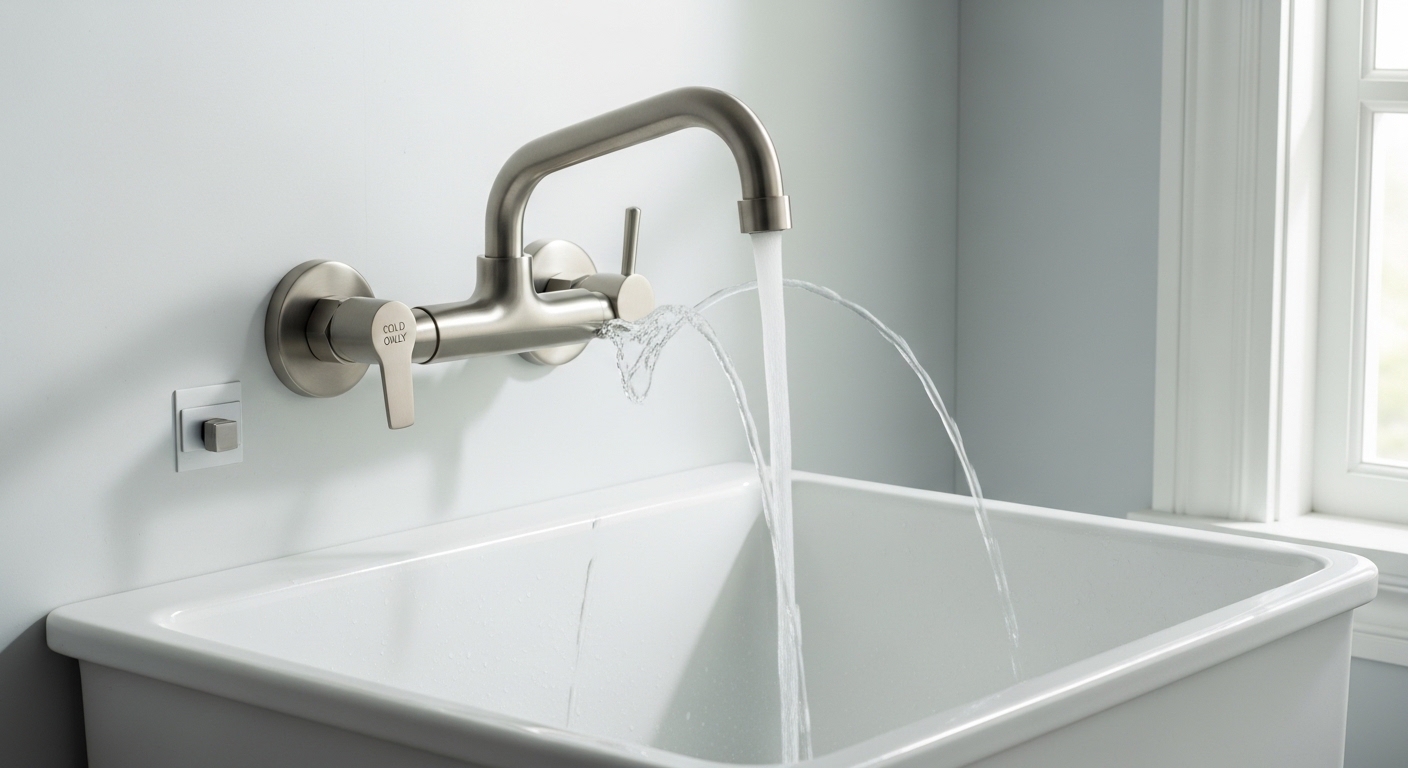
If you’ve been searching for a wall mount faucet cold only setup, you’re almost certainly outfitting a utility area — a laundry room, a garage slop sink, a bar prep station, a garden potting bench, or a commercial mop/service sink — where hot water is pointless and a countertop faucet is in the way. This guide answers the real questions people ask before buying: what these faucets actually are, when a cold-only wall-mount beats a standard two-handle unit, what specs to check, how to install one without leaks, and how to pick a finish and spout reach that survives daily abuse. No fluff — just what you need to buy the right one the first time.
What exactly is a “cold only” wall mount faucet, and how is it different from a normal faucet?
A cold-only wall mount faucet has one water inlet and one control, and it mounts to the wall behind or above the sink rather than to the sink deck or countertop. That’s the whole idea: one supply line (cold), one handle, one job. A standard bathroom or kitchen faucet has two inlets — hot and cold — that either mix inside the body or feed two separate handles.
Because there’s no mixing, the internal parts are simpler. Most cold-only models use a quarter-turn ceramic disc cartridge or a compression stem — you turn it, water flows, you turn it back, it stops. Fewer parts means fewer failure points and a lower price. Here’s how the common configurations stack up:
| Faucet type | Supply lines | Mount | Best for | Typical price (USD) |
|---|---|---|---|---|
| Wall mount, cold only | 1 (cold) | Wall | Utility, laundry, mop, bar, garden sinks | $30–$120 |
| Wall mount, hot + cold | 2 | Wall | Vessel bathroom sinks, farmhouse kitchens | $90–$400+ |
| Deck mount, cold only | 1 (cold) | Sink/counter | Bar sinks, garden taps, secondary rinse stations | $25–$90 |
| Single-hole mixer (deck) | 2 | Sink/counter | Everyday bathroom/kitchen use | $60–$300 |
The wall-mount part matters as much as the cold-only part. Mounting on the wall keeps the sink deck clear, makes wiping down the basin easier, and works when there’s no deck to drill into — think a wall-hung service sink or a stone slab you don’t want to bore through. If you’re unsure whether your sink even has the room to mount on the deck versus the wall, our guide on what faucet hole size a sink needs and how to measure it walks through the measurements that decide it.
When should you choose cold only instead of a hot-and-cold faucet?
Choose cold only whenever the task never needs warm water — and be honest about that, because it’s most utility jobs. Filling a mop bucket, rinsing gardening tools, topping off a fish tank or a pet’s bowl, hosing down muddy boots, washing paint brushes, or drawing water for a bar sink all work fine at tap temperature. Adding a hot line to those stations just doubles the plumbing, doubles the cost, and adds a scald risk that codes actively try to prevent in public spaces.
Skip cold only when someone will regularly wash their hands, dishes, or produce there for comfort or hygiene, or where warm water genuinely helps cut grease. A laundry room is the classic gray zone: many people pre-treat stains just fine with cold, but if you soak wool or hand-wash delicates in warm water, buy a two-handle wall mount instead.
- Great fit for cold only: garage/basement slop sinks, mop/janitor sinks, garden and greenhouse taps, bar and beverage rinse stations, laundry pre-rinse, workshop cleanup, pet-washing stations.
- Better with hot + cold: primary bathroom vanities, kitchen prep sinks, hand-wash sinks in food service (often code-required to have warm water), delicate laundry stations.
What specs should you check before buying a cold-only wall mount faucet?
Check five specs before you click buy: inlet spacing, connection size, spout reach and height, flow rate, and material. Getting these right is the difference between a faucet that drops onto your existing rough-in and one that forces you to re-plumb inside the wall.
Inlet spacing and connection: Since it’s cold only, you usually have a single inlet — commonly 1/2″ NPT male or female threads. Confirm which your wall stub-out provides. If you’re replacing an old cold-only tap, measure the thread and diameter before ordering an adapter.
Spout reach and height: Reach is how far the spout extends from the wall; height is how tall the arc rises. For a mop bucket or a deep laundry basin, you want a tall gooseneck with 6–9 inches of reach so the bucket clears underneath. For a shallow bar sink, a compact swivel spout is plenty. Measure your basin’s inside edge to the wall first.
Flow rate: Utility faucets often run 1.8–2.2 GPM. If you fill big buckets, a higher flow saves time; if it feeds a small bar sink, an aerated 1.5 GPM is fine and less splashy.
Material and finish: Look for a solid brass body — it resists corrosion far better than zinc alloy (sometimes labeled “zamak”), which can crack over years of thermal and mechanical stress. Stainless steel is also excellent for wet, high-abuse zones. Finish is mostly about the environment: brushed stainless and chrome hide water spots and shrug off cleaners, while decorative finishes look nicer at a bar. If your area has hard water, expect mineral spotting — our guide on cleaning hard water stains and keeping them from coming back will save the finish over the long haul.
How do you install a wall mount cold-only faucet without leaks?
You install it by shutting off the water, connecting the single cold inlet to the wall stub-out with fresh thread sealant, mounting the faucet body to the wall, and pressure-testing before you trust it. Because there’s only one line, this is one of the easiest faucet installs there is — often a 30-to-45-minute DIY job. Here’s the reliable sequence:
- Shut off the cold supply at the local stop valve or the main, then open the old faucet to relieve pressure.
- Remove the old faucet if you’re replacing one. If it fights you or is corroded onto the stub-out, our step-by-step on doing a faucet removal the right way without wrecking your sink applies to wall-mount units too — go slow on old threads.
- Clean and inspect the wall stub-out. The threads must be sound. Wrap male threads with 3–5 turns of PTFE tape or use pipe-thread compound.
- Thread on the faucet or its adapter hand-tight, then snug with a wrench — usually a quarter to half turn past hand-tight. Don’t over-torque; you’ll crack the body or strip the threads.
- Secure the mounting hardware to the wall so the faucet doesn’t rely on the pipe for support. A faucet that wobbles on its inlet will eventually leak.
- Turn the water back on slowly and watch every joint for 60 seconds. A slow weep means you need another wrap of tape or a slight retighten.
One common gotcha: a handle that spins freely and never shuts the water off usually means a stripped stem or a worn cartridge, not a bad install. If you hit that on an existing outdoor-style tap, the fix is the same family of parts described in why an outdoor faucet handle just spins and how to fix it.
Is a wall mount cold-only faucet good for a commercial mop or service sink?
Yes — a cold-only wall mount is a workhorse in commercial mop rooms, and it’s often exactly what code and durability call for. Janitor and service sinks live a hard life: hot buckets, harsh chemicals, banging mop handles. A wall-mounted body keeps the faucet up out of the splash zone, and cold-only plumbing is cheaper to run to a back-of-house closet. For heavy commercial rinsing, some operators pair a cold-only wall faucet with a threaded outlet so they can attach a hose or a spray adapter; if that’s your plan, check compatibility using our breakdown of the commercial kitchen faucet adapter and how to pick the right one.
A few commercial-grade features worth paying for: a solid brass or stainless body, a quarter-turn ceramic cartridge rated for high cycle counts, a vacuum breaker if the outlet is hose-threaded (many local codes require backflow prevention on any faucet a hose can attach to), and a wrist-blade or lever handle that’s easy to operate with a full hand or elbow.
What about rust, hard water, and long-term reliability?
Long-term reliability comes down to two things: the body material and your water quality. A solid brass or stainless faucet on a clean supply line can run trouble-free for a decade or more. The two things that shorten that life are mineral scale from hard water and rust or sediment coming through the pipes.
Scale builds up inside the aerator and on the cartridge, causing weak or sputtering flow. Rust and grit — common on older galvanized supply lines or after plumbing work — can jam the cartridge or clog the outlet entirely. If your cold-only faucet’s flow drops off or the water looks tinted, don’t assume the faucet failed; check the supply first. Our guide on why rust clogs a faucet and how to fix it for good covers flushing the line and cleaning or swapping the aerator, which fixes most “sudden low flow” complaints on utility faucets.
| Problem | Likely cause | Quick fix |
|---|---|---|
| Weak or sputtering flow | Scale in aerator | Unscrew aerator, soak in vinegar, rinse |
| Won’t fully shut off / drips | Worn cartridge or stem | Replace cartridge (cheap, 10-min job) |
| Tinted or gritty water | Rust/sediment in supply | Flush the line, clean the inlet screen |
| Handle spins freely | Stripped stem | Replace stem/cartridge assembly |
| Leak at the wall joint | Bad thread seal | Redo PTFE tape / thread compound |
How much should you spend, and where does Vigafaucet fit in?
For a solid-brass or stainless cold-only wall mount, budget $40–$120; below about $30 you’re usually buying a zinc-alloy body that won’t last in a wet, high-use spot. Spend at the higher end if it’s a commercial service sink, if you want a decorative finish for a visible bar, or if you need a hose-thread outlet with backflow protection.
At Vigafaucet, we design and manufacture faucets and bathroom fixtures for both homeowners and trade buyers, and our utility and wall-mount lines use solid brass bodies with ceramic-disc cartridges pressure-tested before they ship. We publish flow rates, connection sizes, and reach measurements on every product page so you can match a faucet to your rough-in without guessing — which is exactly the spec-matching this article is about.
FAQ
Can a wall mount faucet be cold only, or does it have to have hot and cold?
It can absolutely be cold only. Wall-mount faucets come in both single-inlet (cold only) and dual-inlet (hot and cold) versions. Cold-only models have one supply connection and one handle, which makes them cheaper to buy and simpler to plumb — ideal wherever hot water isn’t needed.
Is a cold-only wall mount faucet good for a laundry room?
It’s a good fit if you mostly pre-rinse and fill with cold water. If you regularly hand-wash delicates or soak in warm water, buy a two-handle wall mount instead. Many laundry rooms actually run fine on cold only, since modern detergents are formulated to work in cold water.
What size connection does a cold-only wall mount faucet use?
Most use a 1/2″ NPT threaded inlet (male or female), matching standard wall stub-outs in the U.S. Always confirm your existing stub-out’s thread type and diameter before buying, and use an adapter only if the threads genuinely don’t match.
Do I need a plumber to install a cold-only wall mount faucet?
Usually not. Because there’s only one supply line and one connection, most people can install one in 30–45 minutes with a wrench, PTFE tape, and the shutoff valve closed. Call a plumber if the wall stub-out is damaged, corroded, or needs to be moved inside the wall.
Why does my cold-only faucet drip even when it’s turned off?
A drip when closed almost always means a worn cartridge or compression stem, not a bad install. These are inexpensive parts and typically swap out in about ten minutes once the water is shut off. If the handle also spins without resistance, the stem is stripped and needs replacing.
Should a cold-only faucet with a hose outlet have a vacuum breaker?
Yes, if a hose can attach to it. Many local plumbing codes require backflow prevention (a vacuum breaker) on any faucet with hose threads to keep contaminated water from siphoning back into your supply. Commercial mop and service faucets almost always include one.
Author note: This guide was written by the Vigafaucet product team, drawing on our experience manufacturing and pressure-testing faucets and bathroom fixtures for residential and commercial buyers. All Vigafaucet utility and wall-mount faucets use solid brass bodies with ceramic-disc cartridges, are tested to relevant flow and durability standards, and are backed by our manufacturer’s warranty. For your specific installation, always follow local plumbing codes and the instructions included with your faucet.
WeChat
Scan the QR Code with WeChat