 English
 Deutsch
 Français
 Italiano
 Español
 Português
 Nederlands
 Polski
 Русский
 日本語
日本語 한국어
한국어 العربية
 China Faucet Factory & OEM/ODM Faucet Manufacturer
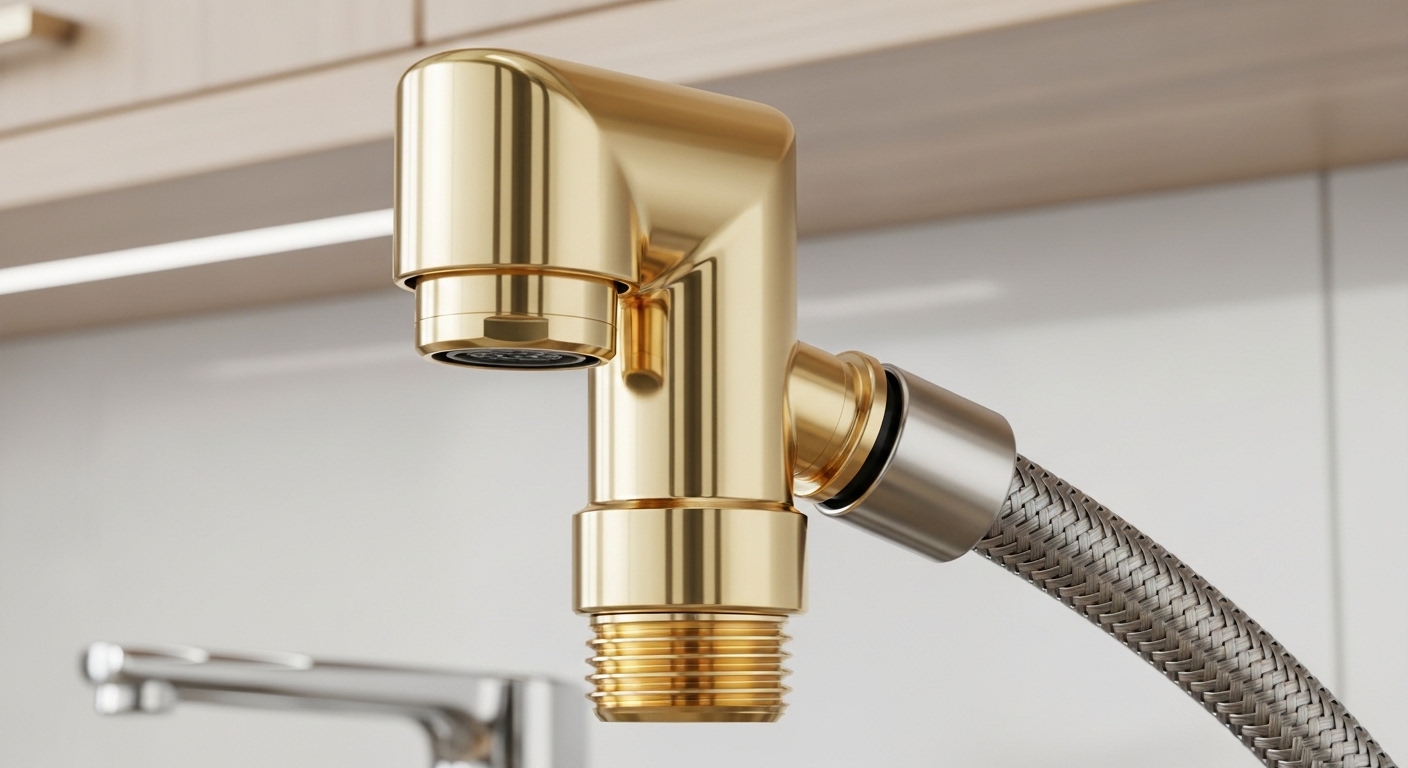
If you’ve ever tried to connect a hose, a portable dishwasher, or an inline water filter to a faucet crammed against a backsplash or a cabinet wall, you already know why a faucet L adapter exists. A straight fitting points the connection dead-ahead and eats up 3–4 inches of clearance you simply don’t have. An L adapter turns that connection 90 degrees, so the hose or line runs along the wall instead of jamming into it. It’s a small brass elbow, but it’s the difference between a clean, leak-free hookup and a kinked, dripping mess.
Below, I’ll walk through exactly what these adapters do, how to figure out which thread you have, the real-world scenarios where an L adapter saves the day, and how to avoid the two mistakes that cause 90% of leaks. I’ve spec’d and installed hundreds of these on kitchen, laundry, and bathroom setups, so this is the practical version — not a parts-catalog dump.
What exactly is a faucet L adapter, and what does it do?
A faucet L adapter is a 90-degree elbow fitting that changes the direction of a threaded faucet connection from straight to sideways (or straight to downward). It has threads on two faces set at a right angle — you screw one face onto the faucet (or supply line) and connect your hose, filter, or fitting to the other.
Think of it as a traffic cop for water. It doesn’t change pressure or flow in any meaningful way; it just reroutes the connection so the attached line runs in a direction that actually fits your space. There are two broad families, and people confuse them constantly:
- Spout / aerator L adapters — these thread onto the tip of your faucet spout where the aerator normally screws in. You use these to attach a garden hose, a portable washing machine or dishwasher fill line, or a countertop water filter to an existing faucet.
- Supply-line L adapters — these go under the sink or behind the wall, between the shutoff valve and the faucet’s supply hose (or between two supply components). They use plumbing threads (NPT or the metric G/BSP series) and solve tight-clearance problems in the cabinet.
Both are “L adapters,” but they use completely different thread standards, so the first job is always figuring out which one you’re dealing with.
How do I know which thread size my faucet L adapter needs?
Match the thread by where it connects: spout-tip adapters use aerator threads (15/16″-27 male or 55/64″-27 female — the two most common in North America), while under-sink supply adapters use 1/2″ NPT, 3/8″ compression, or the metric G3/8″/G1/2″ threads found on many imported faucets.
Here’s the fast way to identify what you have without guessing:
- Unscrew the aerator at the tip of your spout. Look at where it threaded in. If the threads are on the inside of the spout, you need a male adapter (15/16″-27). If the threads are on the outside of the spout, you need a female adapter (55/64″-27). This “inside vs. outside” check is the single most useful test.
- Measure the diameter with a caliper or a ruler. Around 15/16″ (≈24 mm) means standard aerator thread. Smaller “junior” sizes exist on some bathroom faucets, so measure — don’t assume.
- For under-sink work, check the shutoff valve and supply hose ends. In the US you’ll usually see 3/8″ compression or 1/2″ NPT. On European or Chinese-made faucets you’ll often see G3/8″ or G1/2″ (BSP) threads, which look similar to NPT but are not interchangeable — the taper and pitch differ.
If your imported faucet uses metric threads and your local hardware store only stocks NPT, that mismatch is exactly the kind of detail buyers miss when ordering. If you’re sourcing fixtures or parts internationally, it’s worth reading our guide on how to read a faucet quotation from China before you order so the thread spec is confirmed on paper, not discovered mid-install.
When do you actually need a faucet L adapter (real scenarios)?
You need a faucet L adapter whenever a straight connection would kink the hose, hit a wall, or leave no room to hand-tighten the fitting. The four most common real-world triggers are below.
1. Connecting a hose or portable appliance in a tight sink
This is the classic case. You bought a portable dishwasher or a countertop washing machine, and its fill hose points straight out from the faucet — right into the window ledge or backsplash. An aerator L adapter turns that hose down or to the side so it clears the obstruction and doesn’t kink. Kinked fill hoses are the number-one cause of “my portable dishwasher won’t fill” complaints, and a $10 adapter fixes it.
2. Adding an inline or countertop water filter
Many countertop filters use a diverter valve at the aerator. If your faucet sits close to the wall, the diverter and its tubing need to angle away, not forward. An L adapter gives the tubing a clean 90-degree path. If drinking-water quality is your real goal here, it’s worth pairing the adapter with the right filter — our breakdown of the best tap water filter to drink from at home covers what actually removes contaminants versus what just improves taste.
3. Utility, laundry, and mop-sink hookups
Utility and laundry faucets are often mounted high and close to a wall, and you’re frequently attaching a hose or a wringer. An L adapter (usually with a garden-hose thread, GHT 3/4″, on the outlet side) lets the hose drop straight down into a bucket or drain instead of pointing out into the room. If you’re setting up or upgrading that space, see our guide to choosing the best laundry room utility faucet for a utility sink — pairing the right faucet with the right adapter avoids a lot of trial and error.
4. Under-sink clearance problems
Sometimes the faucet’s own supply hoses are too long or angled wrong for a shallow cabinet or a disposal that’s in the way. A supply-side L adapter reroutes the line so it doesn’t press against the cabinet back or bend past its minimum radius. Braided supply lines have a minimum bend radius, and forcing a tighter bend is a slow leak waiting to happen. If you’re rebuilding a supply run, a good copper faucet hose plus a right-angle adapter often gives a cleaner, more durable path than cramming a too-long braided line into the space.
Faucet L adapter vs. straight adapter vs. flexible connector — which should I buy?
Buy an L adapter when direction is your problem, a straight adapter when you just need to change thread size or gender, and a flexible connector when you need to absorb both distance and a gentle bend. Here’s the side-by-side:
| Fitting type | Best for | Clearance needed | Leak risk | Typical price |
|---|---|---|---|---|
| L adapter (90°) | Redirecting a hose/line sideways or down in tight spots | Very low — hugs the wall | Low (one rigid, sealed joint) | $6–$18 |
| Straight adapter | Changing thread size or male/female gender only | High — points straight out | Very low | $4–$12 |
| Flexible connector | Bridging distance with a soft, adjustable bend | Medium (needs bend radius) | Medium (more prone to kinks/wear) | $8–$25 |
| Swivel L adapter | Redirecting and rotating the outlet to aim it | Very low | Low–medium (swivel seal wears over time) | $12–$28 |
My default recommendation: if you know the exact direction you want the line to go and it won’t change, a fixed solid-brass L adapter is the most reliable, longest-lasting choice. If you need to aim the outlet (say, to fill different-sized buckets), spend a few dollars more on a swivel version — just know the swivel’s O-ring is the part that eventually wears.
What material should a faucet L adapter be — brass, zinc, or plastic?
Choose solid brass for anything permanent or under pressure, and reserve plastic only for temporary, low-pressure hose hookups. Material is where cheap adapters fail, so it’s worth 30 seconds of attention.
- Solid brass — the gold standard. Corrosion-resistant, handles hot water and full line pressure, threads don’t strip easily. Look for “lead-free brass” (compliant with the US Safe Drinking Water Act / NSF 61 and the 0.25% lead-content rule) for anything touching drinking water.
- Chrome- or nickel-plated brass — same durability, nicer finish if it’ll be visible. The plating is cosmetic; the brass underneath does the work.
- Zinc alloy (zamak) — cheaper, common on bargain adapters. It works but corrodes faster and can seize onto brass threads over time. Fine for occasional use, not ideal for a permanent connection.
- Plastic (ABS/nylon) — fine for a garden hose or a portable appliance you connect and disconnect. Don’t trust it on a hot-water supply line or anything you’ll leave pressurized and unattended.
One quick weight test at the store: pick up two similar adapters. The noticeably heavier one is almost always solid brass; the light one is plastic or thin zinc. Heft is a surprisingly reliable proxy for quality here.
How do you install a faucet L adapter without leaks?
Install it in four steps: shut off water (only needed for supply-side adapters), match and clean the threads, wrap with PTFE tape or use the built-in washer, and hand-tighten plus a quarter-turn with a wrench — no more. Over-tightening is what cracks fittings and crushes washers; it doesn’t stop leaks, it causes them.
- Shut off the water if you’re working under the sink. For a spout-tip aerator adapter, you can leave the water on — just turn the faucet off.
- Remove the old aerator or fitting and check the threads for grit or old tape. Wipe them clean. Debris under a seal is the second most common leak cause after over-tightening.
- Seal correctly for the joint type. Tapered pipe threads (NPT/BSP) need 2–3 wraps of PTFE (plumber’s) tape in the direction of the thread. Aerator and hose threads usually seal with a rubber or fiber washer instead — do not add tape to those; the washer does the sealing and tape just gets in the way. A worn washer is often the real culprit behind a “leaking adapter.” (The same logic applies to any sealing gasket in a faucet — see our note on the centerset faucet gasket for how washer/gasket seating actually works.)
- Tighten by hand, then snug a quarter- to half-turn with a wrench. Test the direction of the L before final tightening, run the water, and check for weeping at the joint. If it drips, back off, reseat the washer or re-tape, and try again — don’t just crank harder.
What can go wrong, and how do you avoid it?
The two failure modes to watch are thread mismatch (wrong standard or gender) and seal failure (over-tightening, missing washer, or wrong sealant for the thread type). Everything else is minor. A quick checklist to stay out of trouble:
- Confirm the thread standard before buying — NPT and BSP/G threads look nearly identical but won’t seal together properly. This bites people with imported faucets constantly.
- Don’t mix tape and washers. Tapered threads get tape; straight threads with a washer get a washer. Doing both often prevents the washer from seating.
- Match hot-water duty to the material. Plastic on a hot supply line will soften and creep over time.
- Mind the flow. A narrow-bore or cheap adapter can slightly restrict flow. For high-flow uses (filling pots, appliances) pick a full-bore brass adapter.
For deeper commercial or high-flow setups — restaurants, garages, workshops — the adapter selection gets more involved. Our companion guide, what is a commercial kitchen faucet adapter and how to pick the right one, covers the heavier-duty thread standards and flow considerations that matter in those environments.
FAQ
Are all faucet L adapters the same thread size?
No. Spout-tip adapters use aerator threads (most commonly 15/16″-27 male or 55/64″-27 female in North America), while under-sink and supply adapters use plumbing threads like 1/2″ NPT, 3/8″ compression, or metric G3/8″/G1/2″ on imported faucets. Always identify your thread — by removing the aerator and checking whether the threads are inside (male adapter needed) or outside (female adapter needed) the spout — before buying.
Can I use a faucet L adapter to connect a garden hose?
Yes, and it’s one of the most common uses. You’ll want an adapter with an aerator thread on the faucet side and a 3/4″ garden-hose thread (GHT) on the outlet side. The 90-degree angle keeps the hose from kinking against the sink or wall. For frequent connect/disconnect, a brass adapter with a swivel outlet is the most convenient.
Why is my faucet L adapter leaking even after I tightened it?
Usually it’s over-tightening, a missing or damaged washer, or the wrong sealant for the thread type. On aerator and hose threads, the rubber washer seals the joint — replace a flattened washer and hand-tighten plus a quarter-turn, no more. On tapered NPT/BSP threads, use 2–3 wraps of PTFE tape instead of a washer. Cranking harder almost never fixes a leak and often makes it worse by cracking the fitting or crushing the seal.
Is brass really worth it over a cheap plastic adapter?
For anything permanent, pressurized, or carrying hot water — yes. Solid, lead-free brass resists corrosion, won’t strip its threads, and lasts for years. Plastic is fine only for temporary, low-pressure hookups you connect and disconnect, like a garden hose or portable appliance. A quick weight check tells you a lot: the heavier adapter is almost always brass.
Will a faucet L adapter reduce my water pressure or flow?
A quality full-bore brass adapter has a negligible effect on pressure. Very cheap or narrow-bore adapters can slightly restrict flow because of a smaller internal channel. If you’re using the adapter for a high-flow task like filling pots or feeding an appliance, choose a full-bore solid-brass model to keep flow strong.
Does using an L adapter void my faucet’s warranty?
Adding an external aerator-thread or hose adapter generally does not void a faucet’s warranty, since you’re not altering the faucet’s internal components. That said, warranties vary by brand, so check yours before making permanent under-sink modifications. When in doubt, keep the original parts so you can restore the faucet to stock condition if you ever file a claim.
The bottom line
A faucet L adapter is a small, inexpensive fitting that solves a specific, frustrating problem: connecting something to your faucet when there’s no room to point it straight. Get the thread right, choose solid lead-free brass for anything permanent, seal it correctly (washer or tape, not both), and don’t over-tighten — do those four things and you’ll have a clean, leak-free connection that outlasts the faucet itself.
About the author & VIGA: This guide was written by the product team at VIGA Faucet, a manufacturer and exporter of kitchen and bathroom fixtures with over a decade of experience supplying faucets, adapters, and plumbing components to distributors and homeowners worldwide. Our fittings are produced from lead-free brass and tested to meet international thread and pressure standards, and our fixtures carry a manufacturer’s warranty. The installation and thread-identification advice above reflects hands-on experience fitting these adapters across kitchen, laundry, and bathroom setups. Always confirm your specific thread size before purchasing, and consult a licensed plumber for permanent supply-line modifications.
WeChat
Scan the QR Code with WeChat