 English
 Deutsch
 Français
 Italiano
 Español
 Português
 Nederlands
 Polski
 Русский
 日本語
日本語 한국어
한국어 العربية
 China Faucet Factory & OEM/ODM Faucet Manufacturer
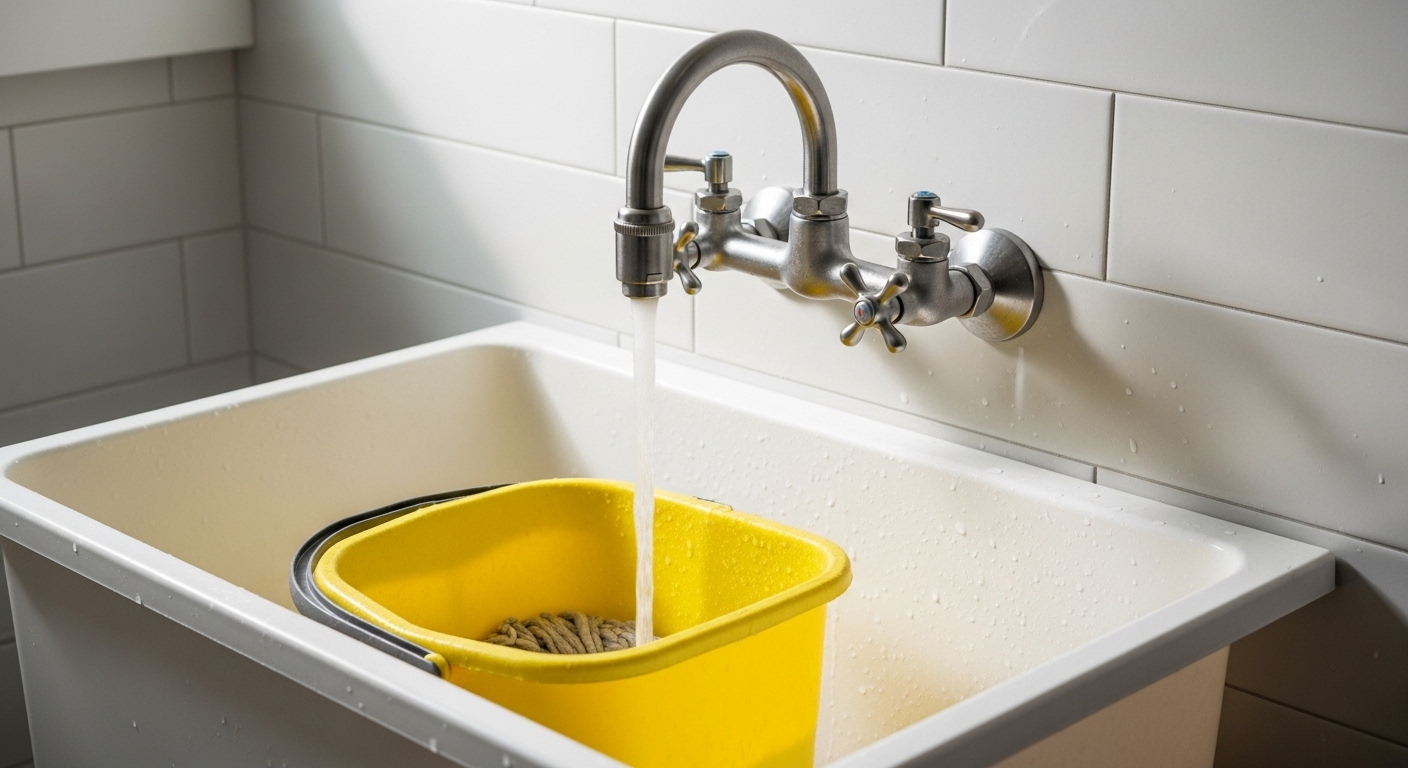
A good laundry room utility faucet is the workhorse most people ignore until it drips, spins loose, or won’t reach the bottom of a mop bucket. Unlike a bathroom or kitchen faucet, a utility faucet in a laundry room, garage, mudroom, or basement gets abused: hot water for hand-washing wool, a garden hose threaded on for the pressure washer, a bucket wedged under it, bleach splashes, and hard-water buildup nobody wipes off. So the buying rules are different — you’re optimizing for reach, flow, thread compatibility, and valve longevity, not looks. Below is exactly how to choose one, what specs actually matter, and how to avoid the two mistakes that send people back to the store.
What exactly makes a faucet a “utility” faucet instead of a regular one?
A utility faucet is built for filling and rinsing, not for delicate hand-washing. The three things that define it: a tall spout with a wide swing, valves that survive heavy on/off cycling, and a spout tip that accepts a hose. Everything else is secondary.
Here’s what that means in practice. A standard kitchen faucet spout sits maybe 6–8 inches above the sink deck and pours into a shallow basin. A utility sink (also called a laundry tub or slop sink) is deep — often 10 to 14 inches — and you need to slide a 5-gallon bucket, a mop head, or a dirty roasting pan underneath. So you want a spout with real vertical clearance and a swing arc that clears the whole basin.
The other giveaway is the spout tip. Most laundry utility faucets end in a 3/4-inch garden hose thread (GHT), sometimes with a removable aerator adapter, so you can thread on a hose, a bucket filler, or a washing-machine supply. Regular faucets use a fine 55/64″ or 15/16″ aerator thread that no garden hose will grab. If you plan to connect a hose, this single spec decides whether the faucet works for you.
- Spout height: aim for 8″+ of clearance under the tip for bucket filling.
- Spout reach & swing: a 180°+ swing lets you clear a deep double-compartment tub.
- Outlet thread: 3/4″ GHT if you want to attach a hose; standard aerator if you don’t.
- Valve type: ceramic-disc cartridges for drip-free quarter-turn control.
- Body material: solid brass beats zinc-alloy (“pot metal”) for corrosion and thread wear.
Wall-mount vs. deck-mount: which utility faucet should I buy for my setup?
Buy a wall-mount utility faucet if your water lines come out of the wall (the most common laundry-room setup); buy a deck-mount if your supply lines come up through the sink or countertop. The mounting style is dictated by your plumbing, not preference — get this wrong and installation turns into a project.
Most older laundry rooms and basements have two exposed pipe stubs sticking out of the wall on 4-inch centers, capped or already fitted with an old faucet. That’s a wall-mount, 4-inch centerset situation, and it’s what the majority of laundry utility faucets are designed for. If you’re replacing an existing wall faucet, measure the distance between the two supply nipples center-to-center; 4 inches is standard, but confirm it.
Deck-mount faucets sit on the rim of the utility sink or on a countertop, with supply lines running up from below through pre-drilled holes. If you’re buying a new plastic laundry tub, check how many holes it has and their spacing before you order the faucet. It’s the same measuring discipline you’d use for a bathroom sink — if you’re unsure how holes and spacing work, our guide on what faucet hole size a bathroom sink needs and how to measure it walks through the exact method, and the logic transfers directly to a utility tub.
| Mount type | Best for | Typical spacing | Install difficulty |
|---|---|---|---|
| Wall-mount, 2-handle | Pipes exiting the wall (basements, garages, older laundry rooms) | 4″ centers (adjustable models exist) | Easy — thread onto existing nipples |
| Deck-mount, 2-handle | Laundry tubs / counters with top holes | 4″ centerset or 8″ widespread | Moderate — need access below the basin |
| Single-handle deck-mount | Simple fill/rinse where hot+cold blend matters | Single hole | Moderate |
| Cold-only wall faucet | Hose bibb duty, no hot water needed | Single nipple | Easiest |
One special case: if you genuinely only need cold water — say the faucet just feeds a hose or fills buckets and you never hand-wash anything — a single cold-supply setup is cheaper and simpler. We cover when that actually makes sense in what a wall mount faucet cold only is and when you should buy one. For most laundry rooms, though, you’ll want hot and cold.
How much should a good laundry room utility faucet cost in 2026?
Expect to spend $40–$80 for a serviceable homeowner-grade utility faucet, $80–$150 for a solid-brass model with ceramic valves that’ll last a decade, and $150–$300+ for genuine commercial-grade fixtures with pre-rinse springs or foot pedals. For a busy home laundry room, the $80–$150 tier is the value sweet spot.
Here’s the honest breakdown of what your money buys:
- Under $40: usually zinc-alloy body, rubber-washer stems (the kind you tighten harder and harder until they strip). Fine for a rental you’ll leave in two years. These are the faucets that “spin freely” a year later — a failure we describe fixing in why an outdoor faucet handle just spins and how to fix it, and the same worn-stem problem hits cheap utility faucets.
- $40–$80: mix of brass and zinc, often with ceramic-disc cartridges. A reasonable buy if the body is solid brass.
- $80–$150: solid-brass body and spout, ceramic-disc quarter-turn valves, GHT outlet, real warranty. This is what most people should buy.
- $150+: commercial-duty — heavy-wall brass, pre-rinse spray, wrist-blade handles, sometimes NSF-listed for food service.
The number that predicts longevity best isn’t the price — it’s the valve. Ceramic-disc cartridges seal metal-on-ceramic and shrug off grit and hard water; rubber-washer compression stems wear out and drip. Pay for ceramic.
Do I need a commercial-grade utility faucet for a home laundry room?
No — for a home laundry room, a residential solid-brass utility faucet is plenty. True commercial-grade fixtures (pre-rinse units, foot-pedal valves, NSF-listed pot fillers) are built for restaurant and industrial duty cycles you’ll never hit at home. But there’s a middle path worth knowing about.
If you run a home business, a busy garage/workshop, a groomer setup, or a utility sink that sees dozens of fill cycles a day, a light-commercial faucet earns its keep: heavier brass walls, replaceable everything, and often a threaded outlet that accepts commercial adapters. If you’re adapting a commercial-style faucet to a home hose or fitting, the sizing gets fiddly — our breakdown of the commercial kitchen faucet adapter and how to pick the right one explains the thread standards so you don’t end up with a leaky mismatch.
For a normal household — washing gardening tools, filling the dog’s kiddie pool, soaking laundry, rinsing paintbrushes — skip the commercial premium. Put that money into a solid-brass residential unit with a good warranty instead.
What features actually matter when buying a laundry room utility faucet?
The features that matter, in order: valve type, body material, spout reach and height, outlet thread, and finish durability. Everything marketing highlights beyond these is mostly noise for a utility faucet.
Valve type — the single most important spec
Ceramic-disc cartridges give you a smooth quarter-turn from off to full flow and almost never drip. Compression (rubber washer) valves are cheaper but wear out, and cartridge/ball designs sit in between. For a faucet that gets cranked hard by someone with wet, soapy hands, ceramic disc is the durable choice.
Body and spout material
Solid brass resists corrosion, holds threads (critical where you screw a hose on and off), and tolerates hot water without warping. Zinc-alloy bodies are lighter and cheaper but crack and corrode over years of hose duty. Lift the faucet in the store — brass is noticeably heavier. Stainless steel is also excellent if you can find it.
Spout style and reach
A high-arc gooseneck clears buckets; a lower straight spout directs flow neatly into the tub. Gooseneck is the safer pick for laundry rooms because of bucket clearance. Look for a spout that swings a full 180°–360° if your sink has two compartments.
Finish
Chrome and stainless are the practical laundry-room finishes: cheap to make, tough, and easy to wipe. Matte black and brushed finishes look great but show hard-water spots faster in a room where nobody polishes the faucet. Whatever you pick, expect mineral scale if you have hard water — here’s how to clean hard water stains on a faucet and keep them from coming back, which matters more on a utility faucet than anywhere else in the house.
How do I install a laundry room utility faucet myself?
You can install a wall-mount utility faucet in about 30–45 minutes with an adjustable wrench, plumber’s tape, and a rag — no soldering required if your supply nipples are already threaded. The core steps: shut off water, remove the old faucet, wrap threads, hand-thread the new faucet, then snug it with a wrench.
- Shut off the water at the laundry valves or the main, then open the old faucet to drain pressure.
- Remove the old faucet by unthreading it from the wall nipples (or unbolting a deck-mount from below). Clean the old thread tape off the nipples.
- Wrap the male threads with 2–3 turns of PTFE plumber’s tape, clockwise.
- Hand-thread the new faucet onto both nipples evenly so it seats square to the wall — don’t cross-thread.
- Snug with a wrench, about a quarter to half turn past hand-tight. Don’t over-torque a brass body.
- Turn the water back on slowly and check for leaks at the connections. Run hot and cold, then thread on your hose or aerator and test flow.
If your old faucet fights you or you’re worried about damaging the sink or wall, the removal principles in our guide to bathroom faucet removal the right way apply almost exactly — go slow, support the fixture, and don’t muscle corroded connections.
Which type of laundry utility faucet is right for me? A quick comparison
If you want the short version: two-handle wall-mount for most homes, single-handle deck-mount for convenience, commercial for heavy use, cold-only for pure hose duty. Match the type to how you actually use the sink.
| Faucet type | Reach/clearance | Hose-ready? | Best use case | Typical price |
|---|---|---|---|---|
| 2-handle wall-mount | High gooseneck, great | Usually yes (GHT) | Standard laundry room / basement | $60–$150 |
| Single-handle deck-mount | Medium–high | Often, via adapter | Frequent hot/cold blending | $70–$160 |
| Commercial pre-rinse | Very high, flexible | Yes | Home business, heavy rinsing | $150–$350 |
| Cold-only wall faucet | Varies | Yes | Hose bibb, bucket fill only | $30–$70 |
FAQ
Can I connect a garden hose to a laundry room utility faucet?
Yes, if the spout outlet is 3/4-inch garden hose thread (GHT), which most laundry utility faucets use. Just unscrew the aerator adapter if one is fitted and thread the hose on. If your faucet has a standard fine aerator thread instead, buy an aerator-to-GHT adapter — a $5 part at any hardware store.
What’s the difference between a utility faucet and a regular kitchen faucet?
A utility faucet prioritizes reach, valve durability, and hose compatibility over aesthetics and features. It typically has a taller spout for bucket clearance, tougher ceramic-disc valves for heavy cycling, and a 3/4″ GHT outlet, whereas a kitchen faucet focuses on spray modes, pull-down heads, and finish looks. Utility faucets are also usually cheaper for the same build quality because they skip the styling.
Why does my utility faucet drip even after I tighten it?
A persistent drip usually means a worn valve — a compression rubber washer that’s flattened, or a scored ceramic disc from hard-water grit. Tightening the handle harder just wears it faster. Replace the cartridge or washer (a $5–$20 part), or upgrade to a ceramic-disc faucet if you’re still on old compression stems. If the handle spins with no resistance, the stem itself is stripped and needs replacing.
Do laundry utility faucets come with a warranty?
Better ones do — quality residential utility faucets typically carry a limited lifetime warranty on the finish and function, or at least 5 years on the cartridge. Cheap zinc-alloy models often have no meaningful warranty. Always check whether replacement cartridges are covered and how you claim them, because the cartridge is the part most likely to fail. Look for faucets whose valves are tested to industry cycle standards (many are rated to 500,000+ open/close cycles).
Should I get a single-handle or two-handle utility faucet?
Two-handle is the traditional, more reliable choice for a utility sink — separate hot and cold stems are simple to service and cheap to repair, and they match the 4-inch wall nipples most laundry rooms already have. Single-handle is more convenient for one-handed temperature control when your other hand is full, but it’s a bit pricier and the single cartridge is a single point of failure. For pure durability and easy repair, choose two-handle.
What spout height do I need for filling buckets in a laundry room?
Aim for at least 8 inches of clearance between the spout tip and the sink bottom so a standard bucket or watering can fits underneath. A high-arc gooseneck spout usually gives 9–12 inches. If you regularly fill 5-gallon buckets, measure your bucket’s height and add an inch of pouring room before you buy.
About the author: This guide was written by the product team at Vigafaucet, drawing on hands-on testing of wall-mount and deck-mount utility faucets across residential and light-commercial installs. We’ve bench-tested valve cartridges for drip resistance and cycled hose-thread outlets to check for thread wear.
About Vigafaucet: Vigafaucet is a manufacturer and online retailer of faucets and bathroom fixtures serving both homeowners and trade buyers. Our utility and commercial faucets use solid-brass bodies and ceramic-disc cartridges tested against industry cycle-life standards, and are backed by a manufacturer warranty on finish and function. Browse our full range at www.vigafaucet.com.
WeChat
Scan the QR Code with WeChat