 VIGA Faucet Manufacturer
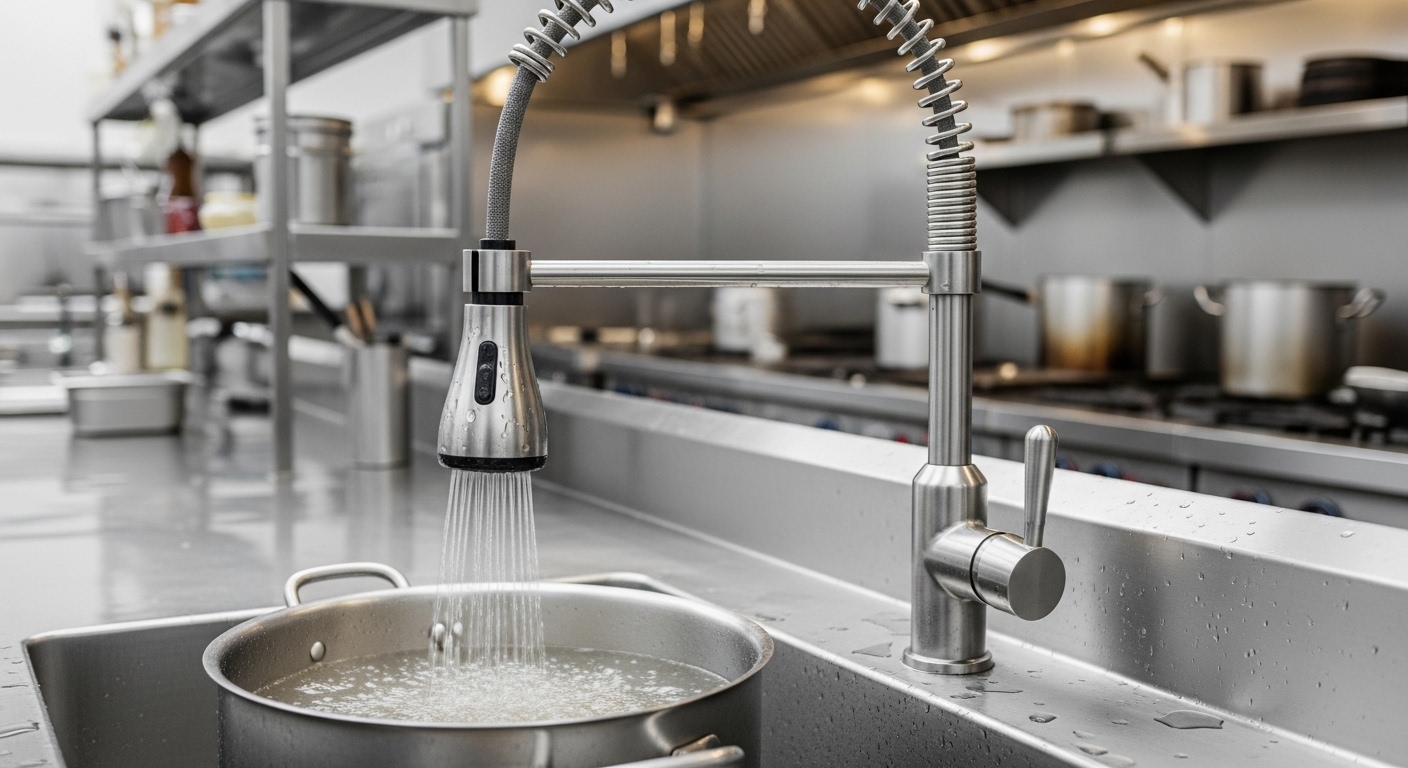
If you run a restaurant line, a coffee bar, a prep station, or even a heavy-use residential island, a commercial kitchen faucet with sprayer pull out spray is the workhorse you reach for a thousand times a day. It has to blast baked-on cheese off a sheet pan, fill a stockpot, rinse a full bus tub, and then tuck the spray head neatly back into the spout — all without dripping, sticking, or wearing out in six months. The problem is that “commercial” gets stamped on a lot of faucets that aren’t built for real commercial abuse. This guide walks you through exactly what to look for, what to skip, and how to match the faucet to your actual workflow and budget.
What exactly is a commercial kitchen faucet with a pull-out sprayer, and how is it different from a pull-down?
A commercial kitchen faucet with a pull-out sprayer is a faucet whose entire spray head detaches from the end of the spout and pulls straight out toward you on a flexible hose — as opposed to a pull-down, where the head pulls vertically down from a tall gooseneck arch. In a working kitchen, pull-out is often the smarter choice because you get a longer usable reach (18–30 inches of hose is common), a lower profile that fits under low shelving or cabinets, and a more natural angle for filling pots on a counter beside the sink.
The “commercial” part isn’t just marketing when the faucet is built right. A true commercial-grade unit uses a heavier brass or stainless body, a ceramic-disc cartridge rated for hundreds of thousands of cycles, and a spray head with a genuine high-pressure jet mode — not just a soft aerated stream. The trade-off is that pure commercial “pre-rinse” units (the tall spring-coil sprayers you see behind the line) are overkill and awkward for many spaces, which is why the hybrid pull-out commercial-style faucet has become so popular for both light-commercial and residential heavy-duty use.
Pull-out vs. pull-down vs. pre-rinse: which one fits your kitchen?
Short answer: choose pull-out for reach and low clearance, pull-down for tall-pot filling under a high arch, and a full pre-rinse unit only if you’re washing dishes at industrial volume all day. Here’s the side-by-side so you can match it to your setup.
| Faucet Type | Best For | Reach / Clearance | Typical Flow | Price Range |
|---|---|---|---|---|
| Pull-out sprayer | Low cabinets, prep sinks, wide counters, pot filling to the side | Long horizontal reach, low profile | 1.5–2.2 GPM | $120–$350 |
| Pull-down sprayer | Deep single-bowl sinks, tall pots, open kitchens | Tall arch, downward spray | 1.5–1.8 GPM | $130–$400 |
| Commercial pre-rinse | High-volume dish pits, heavy grease removal | Very tall spring coil, powerful jet | 1.15–2.2 GPM | $200–$600+ |
What features actually matter in a commercial pull-out faucet — and which are just marketing?
The features that matter are the ones you can’t see from a product photo: the cartridge, the hose, the body material, and the spray mechanism. Everything else — the finish, the exact height of the arc, the shape of the handle — is comfort and looks. Get the internals right and a faucet lasts a decade; get them wrong and no finish will save you.
Here’s what to prioritize, roughly in order of importance:
- Solid brass or stainless body. Zinc-alloy or plastic bodies are the number-one reason cheap “commercial” faucets crack and leak. Brass resists corrosion and holds threads under repeated wrench-tightening.
- Ceramic-disc cartridge. Look for a cartridge rated to 500,000 cycles or better. This is the part that controls temperature and flow, and it’s what fails first on a bad faucet.
- Stainless braided hose (not vinyl). A nylon-braided stainless hose survives being yanked hundreds of times a day. Check the quick-connect fitting too — that’s a common leak point.
- Dual spray modes with a real jet. You want an aerated stream for filling and a concentrated high-pressure spray for scrubbing. A magnetic or ball-catch docking system keeps the head from drooping over time.
- Lead-free certification. NSF/ANSI 61 (drinking-water safety) and NSF/ANSI 372 (lead content) are non-negotiable for any faucet where food or drinking water is involved. In a licensed commercial kitchen, this is usually a code requirement, not a nicety.
- Flow rate matched to your rules. Many U.S. jurisdictions cap kitchen faucets at 2.2 GPM; California and a few others push toward 1.8 GPM. Commercial pre-rinse valves are separately regulated. Check local code before you buy.
What’s mostly marketing? “Spot-resist” coatings help a little but aren’t magic, “touchless” sensors add failure points in a greasy environment, and extreme arc heights look dramatic but can splash in a shallow bowl. None of those should outrank body material or cartridge quality on your list.
How much should you spend on a commercial kitchen faucet with sprayer pull out spray?
For genuine commercial-grade quality you should budget $150–$300, with $120 as a realistic floor for a light-commercial pull-out and $400+ only if you need a tall pre-rinse setup or a premium finish. Spending under about $100 almost always means a zinc body, a vinyl hose, and a cartridge that starts dripping within a year — which costs you more in downtime and replacement than the money you saved.
Here’s how the price tiers actually break down in practice:
- $120–$180: Solid single-handle pull-out with a brass or stainless body and a decent ceramic cartridge. Good for prep sinks, coffee bars, small kitchens, and heavy home use.
- $180–$300: The sweet spot. Better docking, longer stainless hose, dual or triple spray modes, warranty-backed cartridge, verified NSF certification. This is what most working kitchens should buy.
- $300–$500+: Tall commercial pre-rinse styling, premium PVD finishes, extended hoses, and brand-name cartridges. Worth it only if your volume or aesthetics demand it.
Remember that a faucet is a five-to-ten-year purchase in a commercial setting. Amortized over that lifespan, the difference between a $110 faucet and a $220 faucet is a few dollars a month — trivial compared to the cost of a leak over your prep station during a Friday dinner rush.
Will a commercial pull-out faucet fit your existing sink and connections?
Most commercial pull-out faucets are single-hole, deck-mounted units that fit a standard 1.375-inch (35 mm) faucet hole, but you have to confirm your sink’s hole count, deck thickness, and supply-line type before you order. A three-hole sink can still use a single-hole faucet if you add a matching escutcheon (base plate) to cover the extra holes — most quality faucets include one.
Run through this quick pre-purchase checklist:
- Count your holes. One-hole, three-hole (8-inch spread), or four-hole? A single-hole faucet plus a deck plate covers almost everything.
- Measure deck thickness. Commercial stainless decks are thin; residential granite can be 1.5 inches thick. Make sure the mounting shank and nut are long enough.
- Check your supply lines. Standard U.S. connections are 3/8-inch compression. If your faucet comes with 1/2-inch or metric fittings, you’ll need an adapter — see our guide to the commercial kitchen faucet adapter so you order the right one the first time.
- Confirm clearance. Measure from the deck to any shelf or window above. Pull-out heads need less vertical room than pull-downs, which is exactly why they win in tight commercial layouts.
If you’re outfitting a back-of-house cleaning station rather than a prep sink, the fittings and codes differ — our walkthrough on commercial mop sink faucet installation covers the rough-in and backflow considerations you won’t need at a food-prep sink but will need at a mop basin.
How do you keep the pull-out sprayer working — and stop it from sticking or dripping?
The two most common complaints with pull-out sprayers are the head not retracting smoothly and the spray head dripping after you shut the water off. Both are almost always fixable in minutes: the retraction issue is usually the hose weight or the hose catching on the supply lines under the sink, and the post-shutoff drip is just water draining out of the hose, which is normal for a second or two.
A few maintenance habits keep a commercial sprayer feeling new:
- Clear the hose path. Make sure the weight and hose can slide freely and aren’t snagging on shut-off valves or a garbage disposal.
- Descale the spray face monthly. Hard water clogs the little rubber jets. Soak the head in white vinegar and rub the nozzles to restore an even spray.
- Check the docking magnet. If the head starts drooping, wipe grease off the magnet or ball catch — buildup weakens the hold.
- Don’t over-yank. Pulling the head to the very end of the hose repeatedly stresses the quick-connect. Train staff to pull smoothly.
If the head genuinely won’t snap back, we walk through every cause in why is my faucet sprayer not retracting. And when it’s time to swap a worn spray head, don’t force it — our step-by-step on how to remove a pull-down kitchen faucet spray head applies to pull-out heads too and shows you how to release the quick-connect without cracking the fitting.
What finish holds up best in a greasy, high-traffic kitchen?
Brushed or satin stainless (and its look-alike, brushed nickel) hides fingerprints, water spots, and light scratches better than any other finish, which is why it dominates commercial kitchens. Polished chrome is easy to wipe down and cheap but shows every smudge; matte black looks great but shows hard-water film and dried soap fast; and warm finishes like brushed gold are usually reserved for front-of-house or residential islands where looks matter more than grease.
For a true working line, prioritize durability of the finish over color. A PVD (physical vapor deposition) coating is far more scratch- and corrosion-resistant than a standard electroplated finish and is worth asking about on any faucet you’ll clean with commercial degreasers. If you’re wrestling with mineral buildup on any finish, our guide to cleaning hard water stains on a faucet shows how to remove the film without scratching the coating.
FAQ
Can I use a commercial-style pull-out faucet in a residential kitchen?
Yes — and many people do. A commercial-style pull-out gives you a heavier build, a stronger spray, and a longer hose than a typical residential faucet, which is great for a busy family kitchen or a large island. Just confirm the flow rate meets your local residential code (often 1.8–2.2 GPM) and that the faucet is NSF/ANSI 61 and 372 certified for drinking water.
What flow rate do I need for a commercial kitchen faucet?
For food prep and general kitchen use, 1.8–2.2 GPM is standard and usually the legal maximum. A dedicated commercial pre-rinse valve for a dish pit is regulated separately and often runs 1.15–1.75 GPM at high pressure. Always check your state and local plumbing code, since California, Colorado, and others cap flow lower than the federal standard.
Are pull-out sprayers reliable, or do they break more than fixed faucets?
A quality pull-out sprayer with a stainless braided hose and a ceramic cartridge is very reliable and typically outlasts a cheap fixed faucet. The moving hose is the only extra wear point, and it’s an inexpensive, replaceable part. Reliability problems almost always trace back to a vinyl hose, a zinc body, or a weak docking magnet — all of which you avoid by buying commercial-grade.
Do I need a plumber to install one, or can I do it myself?
Most single-hole deck-mounted pull-out faucets are a straightforward DIY job with a basin wrench, taking about 30–60 minutes if your supply lines and shut-off valves are already in place. You’ll need a plumber if you’re moving water lines, adding a new hole to a stainless or stone deck, or if local commercial code requires a licensed installer for a permitted food-service space.
Why does my new sprayer drip for a second after I turn it off?
That’s residual water draining out of the hose and spray head, and it’s completely normal for one to three seconds after shutoff. A continuous drip that never stops, on the other hand, points to a worn cartridge or a bad seal in the spray head — that’s a repair, not normal behavior.
What certifications should a commercial kitchen faucet have?
Look for NSF/ANSI 61 (safe for drinking water contact) and NSF/ANSI 372 (lead-free, under 0.25% weighted average lead). Many quality faucets also carry cUPC or IAPMO listing for plumbing-code compliance. In a licensed commercial kitchen these are typically required by your local health and plumbing authority, so verify them before you buy.
The bottom line
The right commercial kitchen faucet with sprayer pull out spray is the one built from the inside out: a solid brass or stainless body, a long-life ceramic cartridge, a stainless braided hose, a real high-pressure spray mode, and the NSF certifications your kitchen legally needs. Match the reach and clearance to your actual sink, budget $150–$300 for a unit that will run for a decade, and pick a brushed stainless finish that shrugs off grease and fingerprints. Do that, and you’ll have a faucet that keeps up with the busiest shift you can throw at it.
Author’s note: This guide was written by the product team at Vigafaucet, a manufacturer and exporter of kitchen and bathroom faucets. Our engineers pressure-test cartridges to 500,000 open-close cycles and salt-spray-test finishes for corrosion resistance, and our commercial-line faucets are produced to meet NSF/ANSI 61 and 372 standards. Every Vigafaucet kitchen faucet is backed by a manufacturer warranty on the body and cartridge — reach us at www.vigafaucet.com for spec sheets, certifications, and wholesale pricing.
WeChat
Scan the QR Code with WeChat